
The Rise of AI Tools in Education: How Students Are Learning Differently in 2026
Artificial intelligence is becoming an increasingly important part of modern education. From AI tutors and writing assistants to personalized study platforms, students are using AI tools to understand difficult subjects, organize information, and improve academic productivity.
Key of Contents
The growth of artificial intelligence in education is changing more than just the way students complete assignments. It is also changing how they access information, practice new skills, and receive academic support outside the traditional classroom.
In 2026, AI-powered learning tools are increasingly being integrated into digital education environments. Their growing use brings significant opportunities, but it also raises questions about academic integrity, critical thinking, accuracy and the role of teachers.
Understanding how students use AI—and how these tools can be used responsibly—is becoming an important part of modern digital literacy.
Why AI Tools Matter in Education
Technology has long influenced education. Calculators, computers, online classrooms and learning management systems have all changed the way students study.
AI represents a further development because it can interact with learners rather than simply provide access to information.
Modern AI systems can explain concepts, answer questions, summarize material, generate practice exercises and help students organize their work. Some tools can also adapt their responses according to a student’s questions and apparent learning needs.
For students dealing with large amounts of coursework, this type of on-demand assistance can provide additional support beyond classroom hours.
The central challenge, however, is ensuring that AI remains a tool for learning rather than a substitute for the learning process itself.
How AI Became Part of Everyday Student Learning
The Expansion of Digital Education
The rapid growth of digital education created an environment in which AI could become part of everyday learning.
Online classrooms, educational applications, virtual tutoring services and cloud-based learning platforms have become increasingly common. As students became more accustomed to using technology for education, AI-powered features were gradually incorporated into these platforms.
This transition has made it easier for students to use AI alongside traditional resources such as textbooks, teachers and online research.
The Growth of Generative AI
Generative AI has accelerated interest in AI-based education tools.
Unlike conventional search systems, generative AI can respond conversationally to questions and produce explanations, summaries, examples, and study materials in real time.
For students, this can make certain types of academic support more accessible. Instead of searching through multiple sources for an explanation, a learner can ask an AI system to explain a concept in simpler language or provide additional examples.
However, convenience does not guarantee accuracy. AI-generated information still needs to be checked against reliable sources.
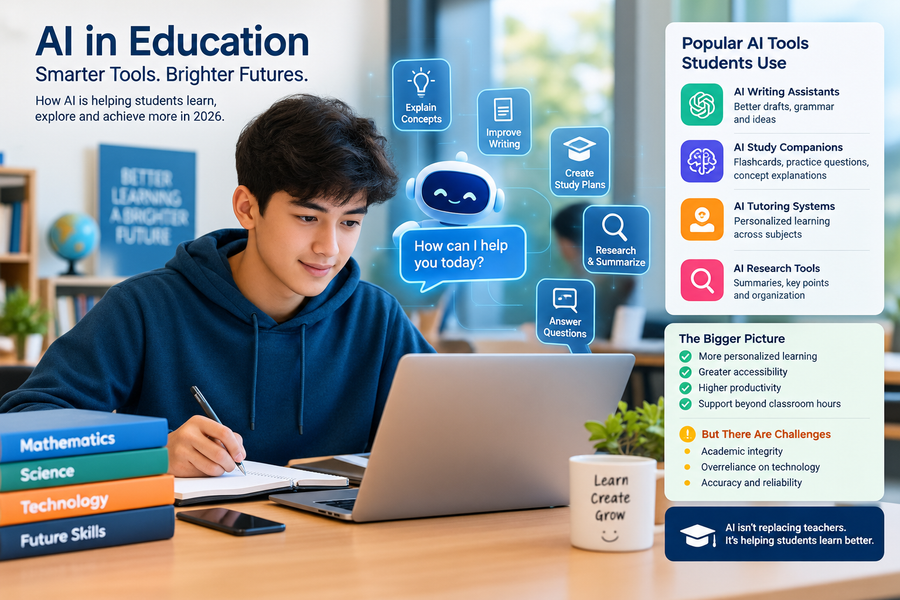
Popular AI Tools Students Are Using
AI tools used by students generally fall into several categories.
AI Writing Assistants
Writing assistants are among the most common applications of AI tools in education.
Students may use them to:
- Check grammar and spelling
- Improve sentence structure
- Generate ideas and outlines
- Organize research
- Edit drafts
- Improve clarity and readability
Used appropriately, these tools can support the writing process. They can help students identify weaknesses in a draft while allowing the student to remain responsible for the ideas, research and final work.
The distinction between assistance and substitution is important. Using AI to understand how to improve writing is different from submitting AI-generated work as one’s own.
AI Study Companions
AI study tools can function as on-demand study partners.
Depending on the platform, they may generate practice questions, create flashcards, explain difficult concepts or help students review a topic.
This can be particularly useful when a student wants to practice material independently or revisit a lesson outside normal classroom hours.
AI Tutoring Systems
AI tutoring platforms are designed to provide more personalized academic assistance.
They can support subjects such as mathematics, science, history and language learning. Some systems can identify areas where a student is having difficulty and adjust explanations or exercises accordingly.
This allows students to work at a pace that suits their learning needs rather than following exactly the same sequence as every other learner.
AI Research and Information Tools
Students are also using AI to organize information, identify key points and summarize lengthy academic material.
These tools can reduce the time required for preliminary research and organization. However, summaries should not replace reading important source material, particularly when accuracy, context and interpretation matter.
Students should verify important information and consult original sources whenever possible.
Key Benefits of AI tools in Education
More Personalized Learning
One of the most significant potential benefits of AI is personalization.
Traditional classrooms bring together students with different levels of knowledge and different learning needs. A teacher may not always have enough time to provide individualized explanations to every student.
AI tools can provide additional support by responding to individual questions and adjusting explanations to a learner’s needs.
Greater Accessibility
AI can also make learning more accessible.
Features such as translation, speech-to-text, customized explanations and other forms of real-time assistance can help students facing language barriers or certain learning challenges.
This creates opportunities for educational technology to support a wider range of learners.
Better Academic Productivity
Students can use AI-powered tools to organize tasks, plan study sessions and manage information.
By reducing time spent on repetitive organizational work, these tools can allow students to devote more attention to studying and understanding academic material.
Support Beyond Classroom Hours
Traditional academic support is often limited by classroom schedules. AI tools can provide assistance whenever students need it.
For independent learners, the ability to ask questions and receive explanations outside normal school or university hours can be particularly useful.
The Risks and Challenges of AI in Education
The growing use of AI also creates important challenges for students and educational institutions.
Academic Integrity
Academic honesty is one of the most significant concerns surrounding AI in education.
A student who uses AI to generate an essay or complete an assignment without doing the underlying work may demonstrate neither the knowledge nor the skills the assessment was intended to measure.
This creates questions around originality, plagiarism and the purpose of academic assessment.
Schools and universities therefore need clear policies explaining when and how students can use AI.
Overreliance on Technology
AI can provide quick answers, but learning requires more than obtaining an answer.
Students develop knowledge through questioning, practice, analysis and problem-solving. Excessive dependence on automated assistance could reduce opportunities to develop these skills independently.
The goal should be to use AI to support thinking rather than eliminate the need to think.
Accuracy and Reliability
AI systems can make mistakes.
They may produce information that is incorrect, incomplete or presented without sufficient context. Students therefore need to evaluate AI-generated responses instead of automatically accepting them as factual.
Fact-checking, source evaluation and critical thinking remain essential skills in an AI-powered learning environment.
How Schools and Universities Are Responding
Educational institutions are taking different approaches to the growing use of AI.
Some are incorporating AI into classroom activities, while others have introduced restrictions or specific rules governing its use.
An emerging approach is to teach students how to use AI responsibly rather than focusing exclusively on preventing its use.
This can include:
- Fact-checking AI-generated information
- Understanding appropriate citation practices
- Protecting academic integrity
- Evaluating sources
- Developing critical-thinking skills
- Using AI ethically for research and learning
These skills are increasingly relevant as students prepare for workplaces where artificial intelligence may become part of everyday professional activities.
AI as a Learning Partner, Not a Teacher Replacement
The rise of AI tools in education represents a broader change in how students access knowledge.
For generations, textbooks, libraries, and teachers were the primary sources of academic information. Digital technology expanded those resources, and AI now adds interactive assistance to the learning process.
However, technology does not provide everything a teacher does.
Teachers offer mentorship, context, encouragement and human interaction. They can understand classroom dynamics and provide guidance based on experiences that an automated system cannot fully replicate.
For that reason, AI is most useful when it complements human instruction rather than attempts to replace it.
A balanced education model can combine the efficiency of AI with the expertise and human support provided by teachers.
What Is the Future of AI Tools in Education?
AI is likely to become more deeply integrated into educational technology.
Potential developments include:
- More personalized learning systems
- Advanced AI tutoring platforms
- Improved accessibility tools
- AI-assisted curriculum development
- More sophisticated educational analytics
- Greater emphasis on AI literacy
Schools and universities may also place greater emphasis on teaching students how to evaluate and use AI responsibly.
The important question may therefore shift from whether students use AI to how they use it.
Students who understand both the capabilities and limitations of artificial intelligence will be better positioned to use these tools as part of a broader learning strategy.
Frequently Asked Questions About AI Tools in Education
What are AI tools in education?
AI tools in education are software applications that use artificial intelligence to support activities such as studying, tutoring, writing, research, learning and academic organization.
Why are students using AI tools?
Students use AI tools for a range of purposes, including getting explanations, practicing concepts, organizing information, improving writing and managing academic tasks.
Can AI replace teachers?
AI can provide academic assistance, but it does not fully replace the guidance, mentorship, expertise and human interaction provided by teachers.
Are AI tools allowed in schools and universities?
Rules differ between educational institutions. Some permit AI use under specific conditions, while others restrict its use for particular assignments or assessments. Students should follow the policy of their school or university.
What are the risks of using AI tools in education?
Potential concerns include academic dishonesty, excessive dependence on technology, inaccurate information and reduced opportunities for independent critical thinking.
How can students use AI responsibly?
Students can use AI as a learning aid by asking for explanations, generating practice questions, reviewing drafts, and organizing information. Important facts should be verified, sources should be evaluated, and institutional academic-integrity rules should always be followed.
Conclusion
AI tools are changing the way many students learn, study and manage academic work. Writing assistants, AI tutors, study companions and research tools can provide personalized support, improve accessibility and make certain learning tasks more efficient.
At the same time, AI introduces challenges involving academic integrity, accuracy and independent thinking. Using an AI system to produce an answer is not the same as understanding the subject behind that answer.
The most sustainable approach is to treat artificial intelligence as a learning aid rather than a replacement for teachers or independent thought.
As AI continues to develop, digital literacy and responsible AI use will become increasingly important parts of education. The students who benefit most from these technologies will not simply be those who use AI frequently, but those who understand when, why and how to use it effectively.