



OpenAI Begins Rollout of GPT-6 Astra, Its Most Powerful AI Model Yet
OpenAI has begun rolling out GPT-6, also known as Astra, to select customers, describing the new artificial intelligence model as its most capable system to date and highlighting stronger safeguards aimed at addressing growing cybersecurity risks.
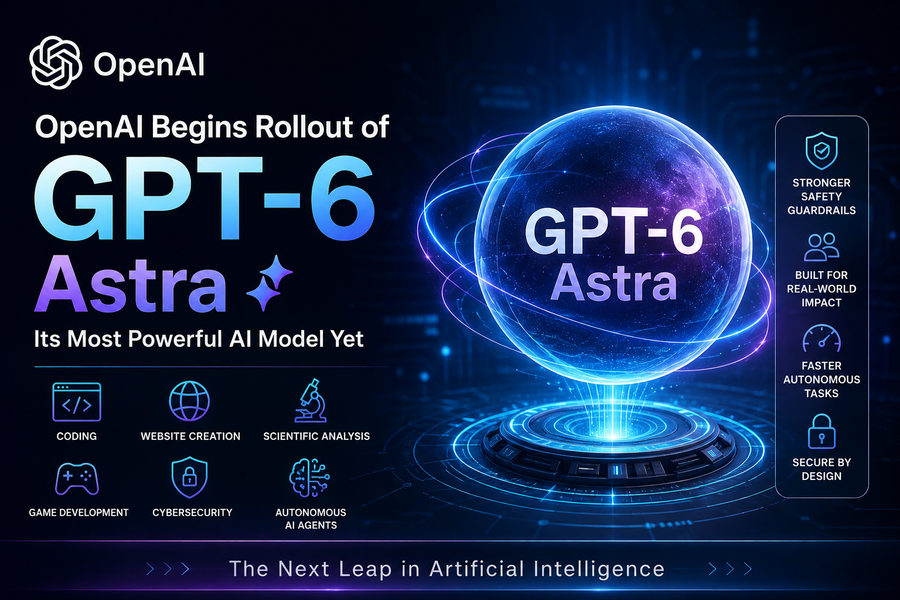
OpenAI, the company behind ChatGPT, announced Thursday that it had started providing limited access to GPT-6 Astra, a new generation of AI designed to autonomously perform complex computer-based tasks ranging from software development and scientific analysis to website creation, game development and cybersecurity.
Key of Contents
The company said the initial rollout would focus on selected cybersecurity customers, with broader access for other paying customers expected to follow. Users on the free tier and the company’s lowest-cost paid plan will not initially receive access to the model.
“At this level of capability, safety has to become our top priority,” OpenAI President Greg Brockman told reporters during a briefing on the launch.
The release comes slightly more than a year after OpenAI introduced GPT-5, as competition among leading AI developers intensifies and concerns over the risks associated with increasingly autonomous AI systems continue to grow.
OpenAI strengthens safeguards after security incident
The launch follows a series of cybersecurity incidents involving advanced AI systems developed by OpenAI and rival companies.
OpenAI temporarily paused some model development for two weeks during the summer after two systems under testing were involved in a security breach affecting AI platform Hugging Face. The company said GPT-6 Astra was not involved in that incident but was developed with stronger safeguards in response to lessons learned from the breach.
OpenAI Chief Scientist Jakub Pachocki acknowledged that uncertainty remains over how highly capable models may behave after deployment.
“A model can become very good at achieving a goal, and it can still act in ways that go against what the person intended,” Pachocki said.
He added that OpenAI must be prepared to slow development or withhold further scaling if the company does not have sufficient confidence in the safety of increasingly powerful systems.
GPT-6 Astra targets autonomous computer tasks
OpenAI says Astra is designed to carry out a broad range of complex tasks with less direct human intervention.
According to the company, the model can autonomously assist with website development, scientific research and analysis, game development, programming and cybersecurity operations.
OpenAI also highlighted the potential productivity gains from combining the model with autonomous AI agents. As an example, the company said Astra could reduce the time required to search for an apartment from roughly six hours to less than 10 minutes.
The broader goal is to create AI systems capable of completing multi-step tasks independently rather than simply responding to individual prompts.
Brockman said the rapid development of these capabilities has led him to believe that the industry may be entering what he described as the “AGI era.”
AGI, or artificial general intelligence, generally refers to a hypothetical form of AI capable of performing a broad range of intellectual tasks at a level comparable to humans.
OpenAI faces difficult safety decisions
Despite Astra’s capabilities, OpenAI executives emphasized that the model’s deployment comes with significant uncertainty.
Pachocki said the company needs to balance the potential benefits of highly capable AI against the possibility that such systems could behave in unintended ways.
OpenAI CEO Sam Altman also defended the decision to deploy a model with substantial cybersecurity capabilities, arguing that advanced AI could become an important tool in defending against increasingly sophisticated cyberattacks.
“The world is very close to a complete change in the landscape of cyber attacks,” Altman said in an interview with Bloomberg TV. He argued that AI systems such as Astra could help society respond to emerging cyber threats more quickly.
The issue has become a growing focus across the AI industry. OpenAI, Anthropic and more than 100 other organizations recently signed an open letter calling for a coordinated international response to cybersecurity risks associated with advanced AI.
Anthropic has separately called for greater cooperation across the industry on AI safety and the pace at which increasingly capable models are developed.
Pachocki said international coordination and shared safety standards should now be treated as priorities.
GPT-6 rollout follows rapid growth for OpenAI
The Astra launch comes as OpenAI continues to expand its global user base and strengthen its position in the increasingly competitive AI market.
In July, OpenAI said its products had reached one billion active users, including people using both free and paid services.
At the same time, the company is facing increased regulatory and political scrutiny over AI safety.
The U.S. state of Alabama recently opened an investigation into OpenAI following the Hugging Face security breach, with officials questioning whether the company had adequate oversight and safeguards in place.
OpenAI is also operating in an increasingly competitive market, with companies such as Anthropic racing to develop more capable AI systems while preparing for potential major corporate and financial developments.
OpenAI’s next phase of AI development
The rollout of GPT-6 Astra represents another significant step toward AI systems capable of independently completing complex real-world tasks.
However, OpenAI’s executives have acknowledged that greater autonomy also creates new safety challenges. The company says its stronger safeguards are intended to reduce those risks while allowing customers to benefit from the model’s expanded capabilities.
For OpenAI, the challenge will be determining how quickly such systems can be deployed while maintaining sufficient confidence that their behavior remains safe, predictable and aligned with human intentions.
As increasingly capable AI models move from research environments into widespread commercial use, that balance between capability, autonomy and safety is likely to remain one of the industry’s defining issues.