



Bangladesh Awaits UN Decision on LDC Graduation Extension
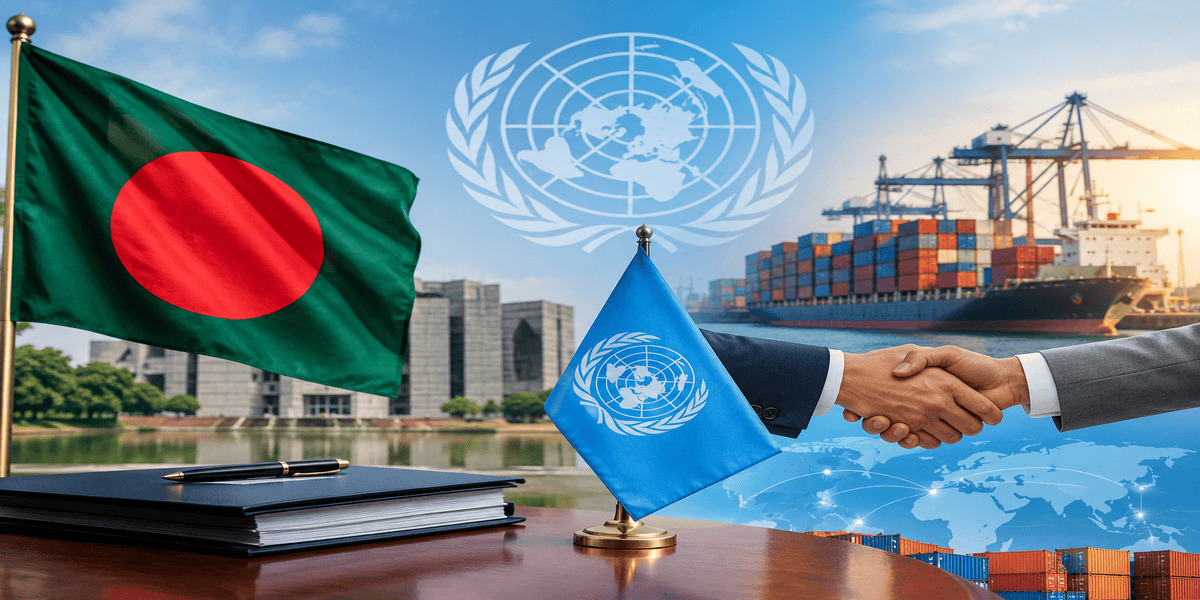
DHAKA, Bangladesh — Bangladesh expects a decision this month on its request for a three-year extension of the preparatory period before graduating from the least developed country (LDC) category, Commerce Minister Khandakar Abdul Muktadir said.
“We anticipate receiving the decision regarding the LDC graduation deferment within the next week. However, if there is any delay, the final decision is expected to be made by the end of this month,” Muktadir stated during a seminar hosted by the Economic Reporters’ Forum (ERF) and the Bangladesh Foreign Trade Institute (BFTI) in Dhaka.
The Group of 77 developing countries has proposed deferring Bangladesh’s graduation, while the European Union has supported its request for a three-year extension.
The U.N. Committee for Development Policy recommended an extension without specifying its duration. The U.N. Economic and Social Council subsequently recommended that the U.N. General Assembly grant Bangladesh a three-year extension.
Bangladesh is scheduled to graduate from the LDC category on Nov. 24, alongside Nepal and Laos, unless the General Assembly approves an extension. Bangladesh and Nepal have requested more time to prepare for the loss of trade preferences and other LDC-specific support measures.
Muktadir said Bangladesh was pursuing trade agreements with major partners to preserve market access after graduation. The country has signed agreements with Japan and South Korea, while negotiations with the United Arab Emirates are expected to conclude next month. Talks with Oman, Singapore, New Zealand and eight to 10 other countries are expected to wrap up by the end of this year or next year.
Bangladesh also hopes to conclude negotiations on a free trade agreement with the EU, its largest export market, before its scheduled graduation in 2029, Muktadir said. Both sides have appointed chief technical officers for the negotiations, he added.
Bangladesh has also shared a time-bound action plan with the EU outlining its preparations for a smooth transition, Muktadir said.
The country is seeking to join the Regional Comprehensive Economic Partnership, a major Asia-Pacific trade bloc. The bloc has established a working group to assess Bangladesh’s application.
BFTI Chief Executive Officer Mostafa Abid Khan said more than 93% of Bangladesh’s exports would remain unaffected during the first two years after graduation. Canada, Japan, the United Kingdom and the EU, which together account for more than 86% of Bangladesh’s exports, have agreed to maintain duty-free market access for three years after graduation, he said.
Abid Khan urged the government to secure trade agreements with major partners to preserve preferential access and avert a potential 26% decline in exports.
After taking office in February, the Bangladesh Nationalist Party-led government wrote to the CDP chair, asking to extend the preparatory period until Nov. 24, 2029. The letter said Bangladesh needed more time to prepare for increased competition in international markets after graduation.
The U.N. has established a working group to review and improve support for countries transitioning out of the LDC category. According to a ministerial declaration from the 81st U.N. General Assembly, the permanent representatives of Angola and Finland will lead the group.