

'Ice Cream Man' Review: Eli Roth Delivers a Gore-Filled Horror Experiment That Struggles Beyond Its Shocking Premise
Eli Roth's Latest Horror Film Trades Storytelling for Extreme Violence in a Divisive Splatter Feature
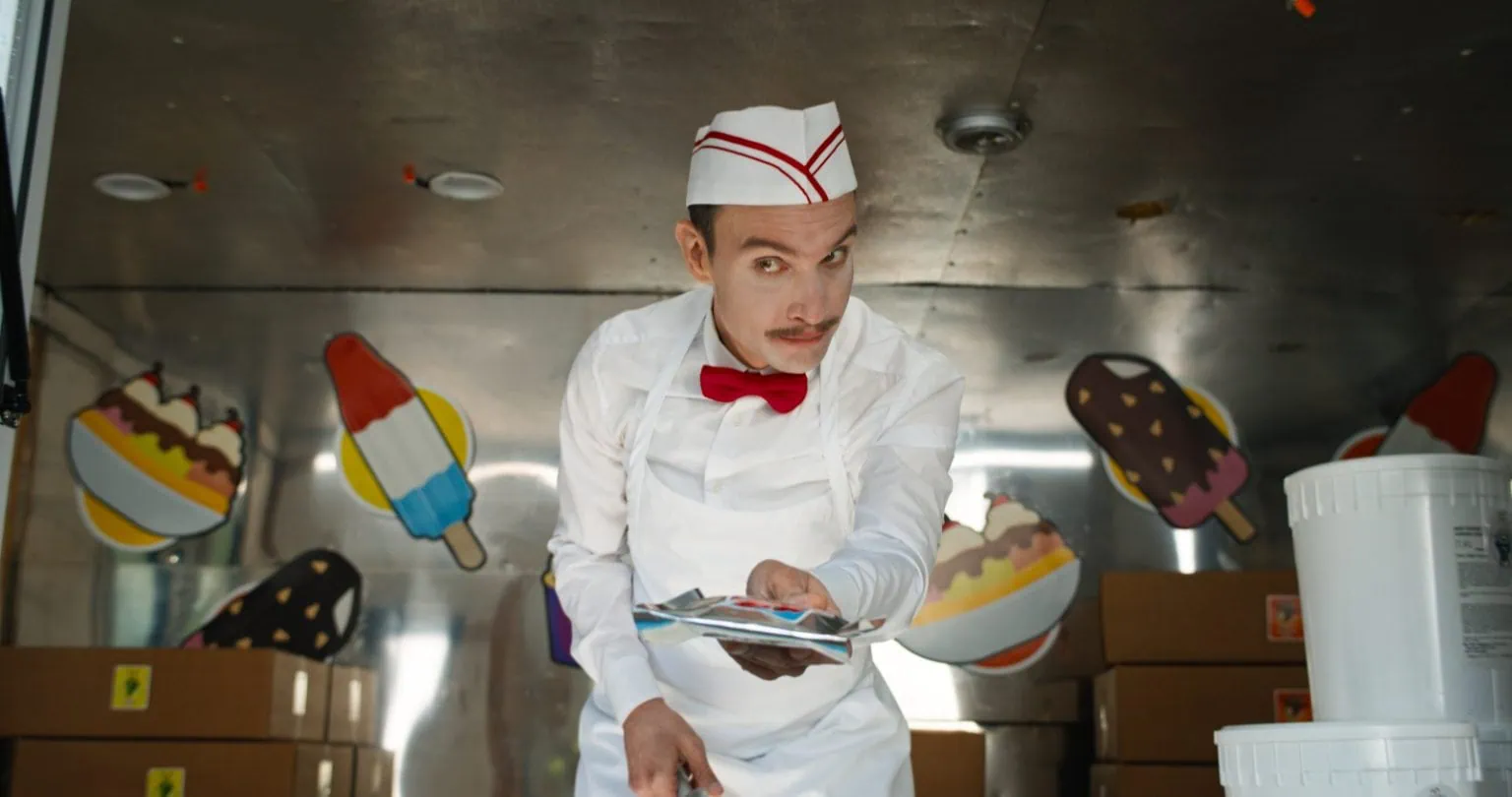
Director Eli Roth has built a career on pushing horror cinema into increasingly graphic territory, earning a reputation for films that combine brutal violence with dark humor. His latest release, Ice Cream Man, continues that tradition with a bizarre premise centered on a mysterious ice cream vendor whose frozen treats transform children into ruthless killers.
While the concept initially promises an outrageous blend of supernatural horror and satirical comedy, the finished film leans heavily on gore at the expense of narrative depth. Packed with practical effects, exaggerated violence, and intentionally outrageous set pieces, Ice Cream Man ultimately delivers a spectacle designed to shock audiences more than genuinely frighten them.
A Small Town Descends Into Chaos
The story unfolds in the peaceful coastal community of Bayleen Bay, where everyday suburban life is suddenly interrupted by an unfamiliar ice cream truck. As children eagerly gather around the colorful vehicle, they are served unusual frozen treats by a silent and unsettling vendor portrayed by Ari Millen.
Rather than offering ordinary desserts, the mysterious ice cream appears to possess supernatural properties. Soon after enjoying the treats, local children begin displaying disturbing behavior before transforming into emotionless killers who target parents, teachers, and other adults throughout the town.
This central premise creates an immediate sense of chaos and recalls several classic horror concepts involving corrupted childhood innocence. However, instead of gradually building suspense or mystery, the film quickly shifts into a relentless series of violent encounters.
A Familiar Horror Formula
The film combines recognizable elements from supernatural horror, zombie stories, and slasher cinema into a single narrative. Viewers may recognize influences from classic “evil children” films while also seeing similarities to more recent horror productions featuring mysterious community-wide threats.
Rather than developing these inspirations into something distinctly original, the movie primarily focuses on escalating violence. The infected children function less as individual characters and more as a collective force that relentlessly hunts adults across town.
As a result, the story becomes increasingly predictable, relying on repetitive attack sequences rather than expanding its mythology or emotional stakes.
Violence Takes Center Stage
One aspect that immediately defines Ice Cream Man is its commitment to graphic practical effects. Roth has long championed old-school makeup techniques and elaborate prosthetics, and this production continues that tradition with numerous elaborate gore sequences.
Throughout the film, everyday household objects become deadly weapons, turning familiar suburban settings into scenes of gruesome violence. From home garages to classrooms and playgrounds, nearly every location becomes the backdrop for increasingly elaborate kills.
The movie rarely pauses between these moments, maintaining a fast pace driven almost entirely by shock value. While horror fans who appreciate practical effects may admire the craftsmanship behind several sequences, others may find the constant emphasis on graphic violence exhausting rather than suspenseful.
The Silent Ice Cream Vendor
Ari Millen portrays the mysterious Ice Cream Man as a nearly wordless figure whose unsettling smile and vintage appearance create an eerie first impression. Dressed in a spotless retro uniform, he resembles a cheerful neighborhood vendor while quietly orchestrating the town’s destruction.
His minimal dialogue leaves much of the character’s personality unexplored, relying instead on visual presence and unsettling behavior. Although this approach adds mystery early in the film, the lack of meaningful character development eventually limits the villain’s impact.
Unlike memorable horror icons whose motivations evolve throughout their stories, the Ice Cream Man largely remains an enigmatic symbol of evil rather than a fully realized antagonist.
A Thin Story Beneath the Gore
As the film progresses, audiences receive an explanation for the villain’s origins through a late-story revelation involving religious institutions and allegations of historical abuse.
Rather than strengthening the narrative, this backstory raises more questions than it answers. The mythology feels disconnected from the rest of the plot, offering an explanation that many viewers may consider overly complicated or implausible.
Because this information arrives near the film’s conclusion, it has little opportunity to deepen the emotional impact of earlier events.
The Young Survivors
Amid the widespread violence, the story follows three children who avoid infection. Leading the group is Jared, a socially awkward boy whose lactose intolerance unexpectedly protects him from consuming the cursed ice cream.
This twist provides one of the film’s more creative ideas, positioning an ordinary medical condition as an unlikely survival advantage.
Unfortunately, the surviving children receive limited character development despite serving as the emotional center of the narrative. Their journey focuses primarily on escaping danger rather than exploring meaningful personal growth or relationships.
Visual Style and Practical Effects
One of the movie’s strongest technical elements is its commitment to practical special effects. Elaborate prosthetics, makeup applications, and physical effects are featured extensively throughout the production.
Many horror enthusiasts continue to appreciate practical effects because they provide a tangible quality that computer-generated imagery sometimes lacks. Ice Cream Man embraces that philosophy wholeheartedly, showcasing numerous handcrafted effects alongside selective digital enhancements.
Although the technical work is often impressive, visual spectacle alone cannot compensate for shortcomings in pacing or storytelling.
Tone Balances Horror and Dark Comedy
The film frequently shifts between gruesome horror and exaggerated comedy. Rather than presenting its bizarre premise with complete seriousness, it embraces an intentionally absurd tone that often borders on parody.
For some viewers, this self-aware approach may enhance the entertainment value by acknowledging the outrageous nature of its concept. Others, however, may feel the humor undercuts any genuine tension, making it difficult to become emotionally invested in the unfolding events.
This tonal inconsistency becomes one of the film’s defining characteristics.
Performance Highlights
Ari Millen delivers an effective physical performance despite having minimal dialogue, relying on facial expressions and body language to create an unsettling presence.
Eli Roth also appears on screen in a supporting role, adding a recognizable face for longtime fans of his work.
The younger cast members successfully portray the eerie transformation from ordinary children into emotionless killers, although the screenplay gives them limited opportunities to develop beyond that central concept.
Strengths and Weaknesses
The film succeeds in creating memorable visual imagery and demonstrates considerable craftsmanship in its makeup and practical effects. Horror fans seeking outrageous gore will likely find numerous moments that showcase Roth’s signature style.
However, the movie’s emphasis on increasingly graphic violence often comes at the expense of suspense, character development, and narrative complexity. Once the central premise is established, the story offers relatively few surprises beyond finding increasingly creative methods of staging violent encounters.
Without stronger emotional investment or a more compelling mystery, the film risks feeling repetitive despite its energetic pacing.
Final Verdict
Ice Cream Man presents an undeniably attention-grabbing concept: a sinister ice cream vendor whose cursed treats transform children into killers. Unfortunately, the imaginative premise is not fully supported by an equally engaging screenplay.
Instead, the film functions primarily as a showcase for elaborate gore effects and over-the-top horror set pieces. While dedicated fans of splatter cinema may appreciate its commitment to practical effects and outrageous violence, viewers seeking psychological tension, compelling storytelling, or memorable characters may find the experience lacking.
Eli Roth remains one of modern horror’s most recognizable filmmakers, and his willingness to embrace outrageous concepts continues to distinguish his work. However, Ice Cream Man demonstrates that even the most inventive horror premise requires strong storytelling to leave a lasting impact. For audiences who enjoy extreme gore and darkly comic horror, the film may provide exactly the chaotic entertainment they expect. For everyone else, its colorful surface may prove far more satisfying than what lies beneath.