



UNICEF Survey Reveals Hidden Scale of Online Sexual Abuse Targeting Children
More than 15 million children were exposed to unwanted sexual content, according to a new UNICEF report examining online risks faced by young people.
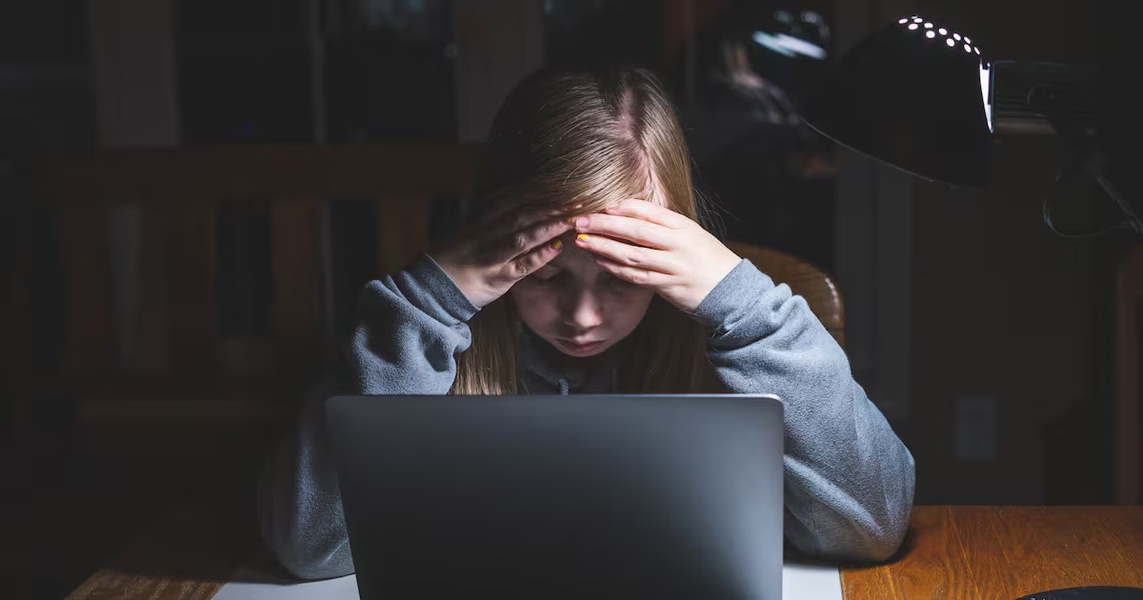
The digital world remains a dangerous environment for many children and teenagers, with a new UNICEF survey finding that about 1 in 5 internet users aged 12 to 17 experienced some form of online sexual abuse or exploitation during the past year.
The report, released by the U.N. children’s agency UNICEF, found that online abuse often escalates rapidly from seemingly ordinary interactions into coercion and exploitation.
“It often begins without warning,” the report’s authors wrote. “Conversation becomes coercion, and coercion becomes entrapment.”
Over 15 million children have been exposed to unwanted sexual content.
The survey estimated that more than 15 million children had been exposed to unwanted sexual content.
About 9 million young people were pressured into sexual conversations or asked to share sexual images, while an estimated 4 million had sexual images shared without their consent.
UNICEF warned that the true scale of online sexual abuse could be significantly higher because many victims never report their experiences.
“The report reveals a painful reality,” UNICEF Executive Director Catherine Russell said. “These experiences cause profound emotional and mental distress. Many children suffer in silence, unsure where to turn for help.”
Many victims never report online abuse.
Shame, fear and pressure from perpetrators can prevent young people from telling others about abuse, according to the report.
The survey found that 41% of respondents had never told anyone about their experience. Those who did disclose abuse often first spoke with friends, siblings or their mothers.
Fewer than 1% of cases were reported to authorities, highlighting what UNICEF described as significant barriers to reporting and seeking help.
Most perpetrators are familiar to their victims.
The report also challenges the perception that strangers primarily commit online sexual abuse.
Only 16% of respondents said the perpetrator was a stranger. In 57% of cases, the alleged perpetrator was known to the victim and could include a friend, family member, or romantic partner.
Another 27% of respondents said they could not identify the person behind the online profile involved in the abuse.
When perpetrators are known to victims, they can be adults or other minors. In some cases, abuse also occurs offline, the report found.
Social media platforms identified as major locations for abuse
Major social media platforms were frequently identified as places where online sexual abuse occurred.
According to the UNICEF report, 60% of reported incidents were primarily linked to Facebook, WhatsApp and Instagram, followed by Snapchat, TikTok and YouTube.
Online gaming platforms were cited by 14% of respondents. Many gaming services include direct messaging features that can allow users to communicate privately.
UNICEF survey included 21,000 young people in 21 countries
The report was based on surveys of about 21,000 internet users ages 12 to 17 across 21 countries.
Data from Ethiopia, Indonesia, Cambodia, Kenya, Malaysia, Mozambique, Namibia, the Philippines, Tanzania, Thailand, Uganda and Vietnam had previously been collected in 2020 and 2021 and analyzed in an earlier report.
Additional research for the new report included Armenia, Brazil, Colombia, the Dominican Republic, Mexico, Montenegro, North Macedonia, Pakistan and Serbia.
Researchers also conducted longer interviews with 100 young people who had experienced abuse.
Previous studies show similar concerns.
The findings are broadly consistent with previous research into online risks faced by children and teenagers.
A 2020 EU Kids Online survey covering 19 European countries found that 22% of participants had received sexually explicit messages online.
A Spanish study conducted in seven secondary schools in 2021 and 2022 found that 21% of female respondents said they had experienced online sexual harassment occasionally, while 5% said it happened frequently.
The figures for male respondents were somewhat lower.
In the United States, a 2022 Pew Research Center survey found that 17% of teenagers ages 13 to 17 had received explicit images without their consent.
UNICEF is urging enhanced protections for children on the internet.
UNICEF called on governments, technology companies and other stakeholders to strengthen protections for children and young people online.
Its recommendations include designing safer digital platforms, improving privacy protections for minors, strengthening national regulations and criminal laws, closing legal loopholes, and establishing reliable reporting and support systems.
The findings come as governments in several countries continue debating restrictions on children’s access to social media.
Australia introduced new age restrictions for social media users in December 2025, while the United Kingdom and several European countries have also considered or proposed measures aimed at strengthening protections for minors online.
The debate over how governments and technology companies should balance child safety, privacy and freedom of expression is expected to intensify as evidence grows about the risks young people face in digital spaces.