

Bangladesh families criticize new enforced disappearance law
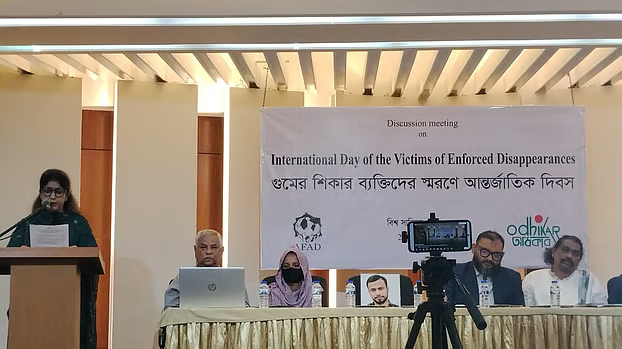
Photo: Prothom Alo
DHAKA, Bangladesh — Families of people who disappeared during successive governments in Bangladesh on Saturday criticized a proposed law on enforced disappearances, saying it fails to ensure independent investigations and could discourage families from reporting cases.
The criticism came at a seminar organized by human rights group Odhikar in Dhaka ahead of the International Day of the Victims of Enforced Disappearances, observed on Aug. 30. About 20 families of missing people and two survivors of enforced disappearance attended the event.
The families also alleged that new cases of disappearance have occurred since the political change of Aug. 5, raising concerns about the government’s ability to prevent such incidents.
Among those attending was 7-year-old Mahir Sheikh, who held a photograph of his missing father, Miraj Sheikh, as his mother, Mukta Khatun, and other relatives appealed for his return.
Khatun said she witnessed Coast Guard personnel taking her husband away in April. She alleged that two men in civilian clothes took Miraj aboard a Coast Guard speedboat near Joymonir Thota in Bagerhat on April 10.
Miraj, who fished in the Sundarbans and also worked as a motorcycle-for-hire driver, had left his motorcycle at a tea stall when he was taken away, Khatun said. She alleged that a man identifying himself as Coast Guard member Robin later collected the motorcycle.
The Coast Guard has denied having Miraj in its custody, according to Khatun.
“I want my husband back,” she said.
Anisha Islam Insha said her father, Ismail Hossain Baten, disappeared from Mirpur-1 in Dhaka on June 19, 2019, and has not been found.
“I want my father. I want little Mahir Sheikh to get his father back,” she said, adding that she opposed both enforced disappearances and the proposed law.
Another participant, Amena Akter, said her husband, Firoz Khan, a Bangladesh Nationalist Party activist and former ward-level Jatiyatabadi Chhatra Dal leader in Barisal, disappeared in 2012. She said she believed members of the Rapid Action Battalion were responsible.
Concerns over proposed law
Tasnim Farhana, Odhikar’s director of training and advocacy, said in a written statement that the draft Enforced Disappearance Prevention and Remedy Act was amended and introduced in Parliament on Aug. 27.
She criticized a provision allowing the government to assign investigations against members of a disciplined force to another force or an inter-agency investigation team.
Farhana argued that investigations should instead be conducted by an independent National Human Rights Commission because investigations by another security force could lack impartiality.
She also criticized a provision that could impose up to five years’ imprisonment with hard labor on a complainant if a disappearance allegation is determined to be false.
According to Odhikar, such a provision could discourage victims’ families from filing complaints and further contribute to impunity.
The organization called for three measures: giving the National Human Rights Commission authority to investigate enforced disappearance allegations; allowing spouses and children of missing people to manage bank accounts and transfer movable and immovable property; and withdrawing what it described as false cases filed against people who returned after being disappeared.
The group also alleged that some survivors had been subjected to torture, forced confessions and false testimony, and that some had received death sentences following such proceedings.
Political criticism
Lawmaker Mir Ahmad Bin Quasem, who said he was himself a victim of enforced disappearance during the previous Awami League government, described the proposed law as inadequate.
He said the provision allowing one security force to investigate another would not ensure independence.
“You are telling us that the right hand can investigate a crime committed by the left hand and that the investigation will be impartial,” he said.
Lawmaker Mahbub Uddin Khokon, president of the Supreme Court Bar Association, also questioned the proposed punishment for unproven complaints.
He referred to the disappearance of opposition leader Elias Ali, whose whereabouts remain unknown, and questioned whether his family could face imprisonment if its allegation could not be proved.
“The law must be universal,” Khokon said.
Other speakers included lawmakers Abdullah Al Amin and Mir Ahmad Bin Quasem, retired Brig. Gen. Hasinur Rahman, former ambassador Maruf Zaman, who returned after being reported missing, and Zahid Hossain, a human rights officer with the U.N. human rights office.
The families at the seminar ended the event by urging the government to locate those who remain missing and ensure that no one is subjected to enforced disappearance.