
How AI Is Transforming Jobs in the United States: The Ultimate 2026 Guide to Careers, Skills & Future Opportunities
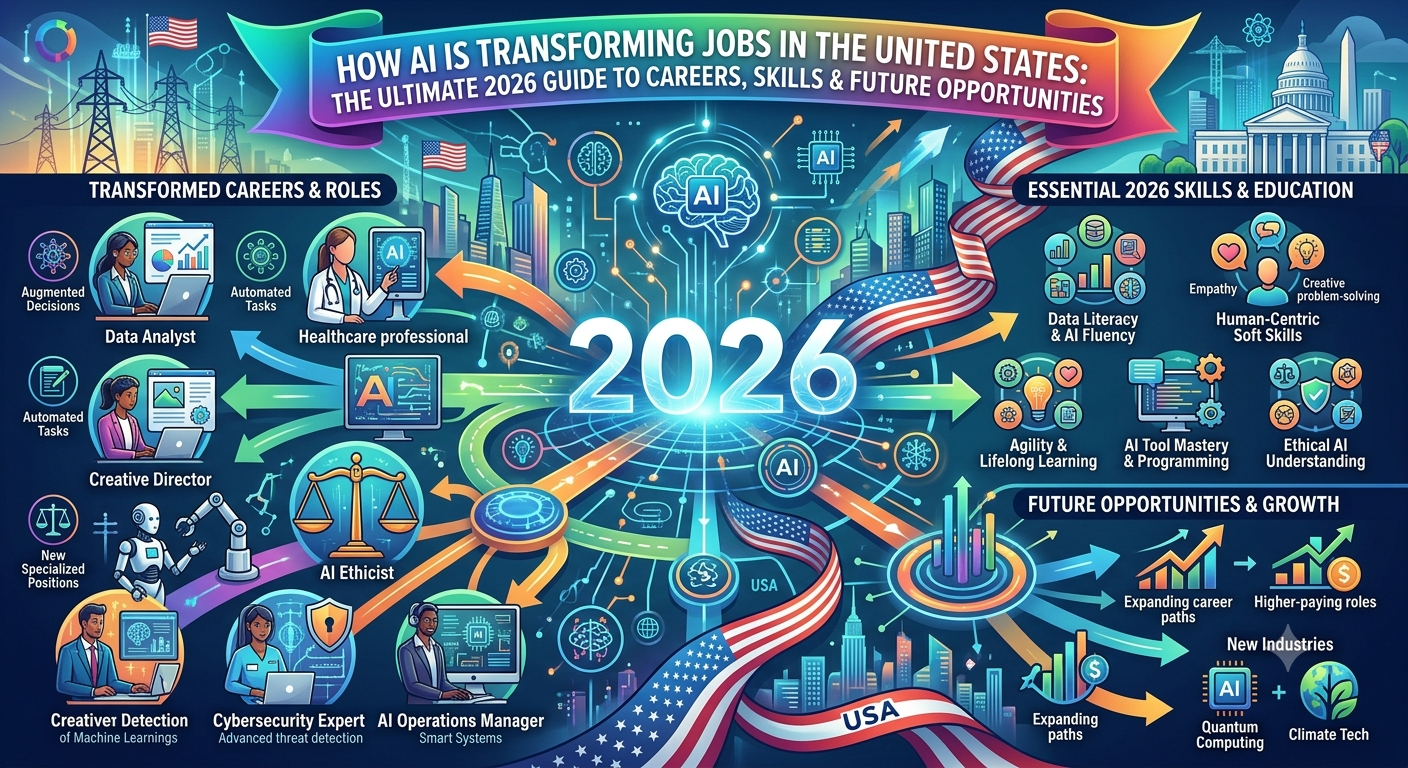
As AI reshapes traditional roles from healthcare to analytics, staying ahead means mastering both smart systems and human-centric soft skills. Check out the infographic breakdown above to explore emerging job titles, essential competencies, and high-growth sectors shaping tomorrow’s job market.
Discover how AI is transforming jobs in the United States, which careers are changing fastest, and what workers can expect next.
Table of Contents
Artificial intelligence is no longer a futuristic concept. It is already reshaping the way Americans work, hire, learn, and build careers. From office workers using AI-powered software to manufacturers deploying intelligent machines, the impact of artificial intelligence is spreading across nearly every industry in the United States.
What makes the current AI revolution different from previous technological shifts is its speed. New AI tools are being adopted at a pace rarely seen in modern business history. Companies are experimenting with automation, employees are learning new skills, and policymakers are debating how to prepare the workforce for major changes.
The result is a labor market that is evolving faster than ever before. While some jobs are becoming more efficient, others are being redefined entirely. Understanding these changes is essential for workers, employers, students, and anyone planning for the future.
Why This Topic Matters
The U.S. economy depends heavily on innovation. Throughout history, technological advances have created new industries while reducing demand for certain types of work.
Artificial intelligence represents the latest stage of that evolution.
AI may carry out jobs that are typically performed by knowledge workers, in contrast to earlier waves of automation that mostly affected physical labor. This means the technology is influencing jobs in finance, healthcare, education, marketing, customer service, law, and many other sectors.
For millions of Americans, the question is no longer whether AI will affect their careers. The question is how quickly those changes will occur and what skills will be most valuable in the years ahead.
The Rise of AI in the American Workplace
Artificial intelligence has been developing for decades, but recent breakthroughs in machine learning and generative AI have accelerated adoption dramatically.
Businesses can now use AI systems to:
- Generate written content
- Analyze large amounts of data
- Automate customer support
- Improve cybersecurity monitoring
- Assist with software development
- Streamline administrative tasks
- Enhance decision-making processes
As these tools become more affordable and accessible, organizations of all sizes are integrating them into daily operations.
Small businesses that once lacked access to advanced technology can now use AI-powered platforms to compete more effectively. Large corporations are investing billions of dollars to improve productivity and reduce operational costs.
The widespread availability of AI tools has created one of the most significant workplace transformations in recent U.S. history.
Which Jobs Are Changing the Fastest?
Not all occupations are experiencing the same level of disruption.
Some professions are seeing rapid transformation because AI can perform portions of their routine tasks efficiently.
Customer Service
AI chatbots and virtual assistants are handling an increasing number of customer inquiries.
While human representatives remain essential for complex issues, many routine interactions can now be managed automatically. This allows companies to provide faster service while reducing response times.
Instead of replacing workers entirely, AI is often changing the responsibilities of customer service teams by allowing them to focus on higher-value interactions.
Marketing and Content Creation
Marketing professionals are increasingly using AI tools to generate ideas, analyze audience behavior, and optimize campaigns.
Content creators can use AI to draft outlines, summarize information, and improve productivity. However, human creativity, strategic thinking, and brand understanding remain crucial components of successful marketing efforts.
Software Development
AI-powered coding assistants are helping developers write, review, and debug code more efficiently.
Rather than eliminating programming jobs, these tools are enabling developers to complete projects faster and focus on more complex challenges.
As a result, software development roles are evolving toward higher-level problem-solving and innovation.
Finance and Accounting
Financial institutions are using AI to analyze transactions, identify fraud, assess risk, and generate reports.
Routine accounting tasks can increasingly be automated, allowing professionals to focus on financial planning, compliance, and strategic analysis.
Healthcare
Healthcare is experiencing a different type of AI transformation.
AI systems can enhance clinical decision-making, help with recordkeeping, and interpret medical pictures. However, doctors, nurses, and healthcare professionals continue to provide essential human judgment, empathy, and patient care.
In many cases, AI serves as a powerful assistant rather than a replacement.
New Jobs Are Emerging Alongside Automation
One of the most important aspects of technological change is that it often creates new opportunities.
Artificial intelligence is generating demand for roles that barely existed a decade ago.
Examples include:
- AI engineers
- Machine learning specialists
- Prompt engineers
- AI ethics consultants
- Data scientists
- AI security analysts
- Automation specialists
Companies also need professionals who can bridge the gap between technical systems and business objectives.
This growing demand has led many workers to pursue training programs, certifications, and educational pathways focused on AI-related skills.
The emergence of these positions demonstrates that AI is not simply eliminating jobs. It is also creating entirely new career categories.
The Skills Employers Want Most
As AI adoption increases, employers are placing greater value on skills that complement technology.
Technical Skills
Workers with expertise in data analysis, programming, cloud computing, cybersecurity, and AI systems are likely to remain highly competitive.
Understanding how AI tools work can provide a significant advantage in many industries.
Human Skills
Despite rapid automation, human-centered abilities remain critical.
These include:
- Critical thinking
- Leadership
- Creativity
- Communication
- Emotional intelligence
- Adaptability
- Problem-solving
These skills are difficult for AI systems to replicate and often become more valuable as technology handles routine work.
The future workforce will likely require a combination of technical knowledge and strong interpersonal capabilities.
Challenges Facing American Workers
The rapid pace of AI adoption also presents significant challenges.
Concerns about job displacement, pay pressure, and future career possibilities are common among workers.
Certain occupations that involve repetitive administrative tasks may face increased automation risks.
At the same time, workers may need ongoing training to keep pace with changing workplace requirements.
This creates pressure on employers, educational institutions, and government agencies to invest in workforce development initiatives.
Without effective retraining programs, some communities could experience greater economic disruption than others.
How Businesses Are Responding
Organizations across the United States are taking different approaches to AI integration.
Some companies view AI primarily as a productivity tool that helps employees work more efficiently.
Others are redesigning entire workflows around automation.
Leading employers are increasingly focusing on:
- Employee upskilling
- AI literacy programs
- Responsible AI policies
- Human-AI collaboration models
- Workforce transition planning
Businesses that successfully combine human talent with AI capabilities may gain a significant competitive advantage in the coming years.
Expert Analysis: Why This Shift Is Different
Every major technological revolution has generated concerns about employment.
The Industrial Revolution transformed manufacturing. Computers reshaped office work. The internet changed communication and commerce.
AI differs because it can perform both routine physical and cognitive tasks.
This expands its influence across a broader range of occupations than many previous technologies.
However, history also suggests that labor markets adapt over time.
New industries emerge, workers acquire new skills, and organizations discover ways to combine technology with human expertise.
The biggest challenge may not be job loss itself but the speed of transition. Workers and institutions must adapt quickly to keep up with rapidly changing demands.
What Happens Next?
The next few years will likely determine how deeply AI reshapes the American workforce.
Several trends are expected to continue:
Greater AI Adoption
More businesses will integrate AI into daily operations as tools become increasingly capable and affordable.
Increased Demand for AI Skills
Workers with AI knowledge and digital expertise will likely remain in high demand across multiple industries.
Expansion of Training Programs
Colleges, universities, and employers are expected to introduce more AI-focused education and workforce development programs.
Regulatory Discussions
Federal and state policymakers will continue debating rules related to AI transparency, privacy, accountability, and employment impacts.
Human-AI Collaboration
The most successful workplaces may be those that combine human judgment with AI efficiency rather than relying exclusively on either one.
Frequently Asked Questions
1. Will AI replace most jobs in the United States?
No. While AI may automate certain tasks, most experts expect it to transform jobs rather than eliminate the majority of them. Many roles will evolve to include greater collaboration with AI systems.
2. Which industries are being affected the most?
Customer service, finance, technology, marketing, healthcare, manufacturing, and administrative services are among the sectors experiencing significant AI-driven changes.
3. What skills should workers learn to stay competitive?
Workers should focus on both technical skills, such as data analysis and AI literacy, and human skills, including communication, creativity, leadership, and critical thinking.
4. Is AI creating new jobs?
Yes. AI is generating demand for positions such as AI engineers, machine learning specialists, data scientists, AI consultants, and cybersecurity professionals.
5. How can employees prepare for future workplace changes?
Continuous learning is essential. Taking courses, earning certifications, improving digital skills, and staying informed about industry trends can help workers remain competitive.
Conclusion
Artificial intelligence is changing jobs in the United States faster than ever before. Its influence extends across industries, occupations, and skill levels, creating both opportunities and challenges for workers and employers alike.
While concerns about automation remain valid, AI is not simply replacing human labor. It is transforming the nature of work itself. Employees who embrace continuous learning, develop adaptable skills, and learn how to work alongside intelligent systems will be better positioned for long-term success.
The future of work in America will likely be defined not by humans versus AI, but by how effectively humans and AI collaborate. As technology continues to advance, the organizations and individuals that adapt most successfully will help shape the next chapter of the U.S. economy.