




KAIST Breakthrough Could Make EV Batteries Smaller, Lighter and More Efficient
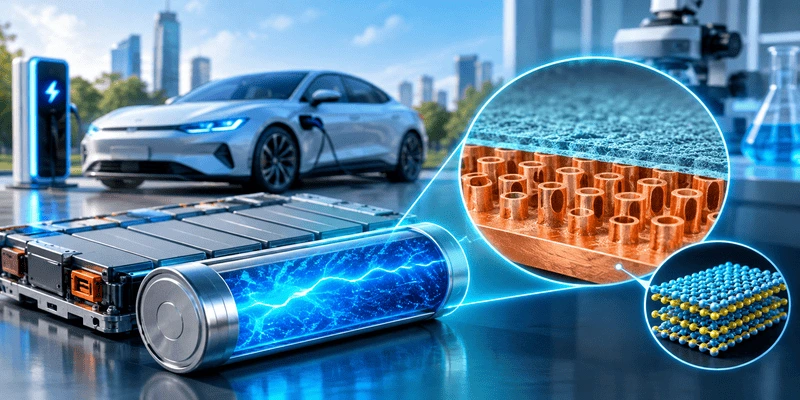
A new battery design developed by South Korean researchers could help address one of the major challenges facing next-generation electric vehicle (EV) batteries: maintaining long-term performance while reducing size and weight.
Researchers at the Korea Advanced Institute of Science and Technology (KAIST) have introduced a surface-engineering technique designed to improve the stability of anode-free lithium batteries. The findings were published in the international scientific journal Advanced Functional Materials.
Unlike conventional lithium-ion batteries, which typically use graphite-based anodes, anode-free batteries do not contain a separate anode material during their initial assembly. Instead, lithium is deposited directly onto a copper current collector during charging. This design can reduce inactive battery components, creating opportunities for higher energy density and more compact battery systems.
However, uneven lithium deposition has remained a significant obstacle to the technology’s development. Repeated charging and discharging can cause lithium to accumulate irregularly on the copper surface, forming needle-like structures known as dendrites. These formations can degrade battery performance and potentially trigger internal short circuits, raising concerns over safety and durability.
To address this problem, the KAIST team developed a modified copper surface featuring densely arranged cylindrical nanostructures, each approximately 300 nanometers in diameter. According to the research findings, the design increases the effective surface area available for lithium deposition by around four times.
The researchers also applied an ultra-thin MXene coating, measuring approximately 10 nanometers, to the engineered surface. The protective layer helps establish a more stable interface inside the battery, encouraging more uniform lithium deposition and reducing the tendency for harmful dendrite formation.
The approach could represent an important step towards overcoming the durability limitations of anode-free lithium batteries. If further developed, the technology may help manufacturers produce smaller and lighter batteries with improved energy-storage potential.
For the electric vehicle industry, such advances could eventually contribute to more compact battery packs and potentially longer driving ranges without relying on substantially larger battery systems.
However, the technology is not yet ready for widespread commercial use. Further testing will be necessary to establish its long-term cycling performance, safety, manufacturing feasibility and commercial viability.
While the research does not mean longer-range electric vehicles are immediately within reach, it offers a promising direction for the development of next-generation battery technology.