



AI Reshapes Workforce as Governments, Businesses Focus on Reskilling Efforts
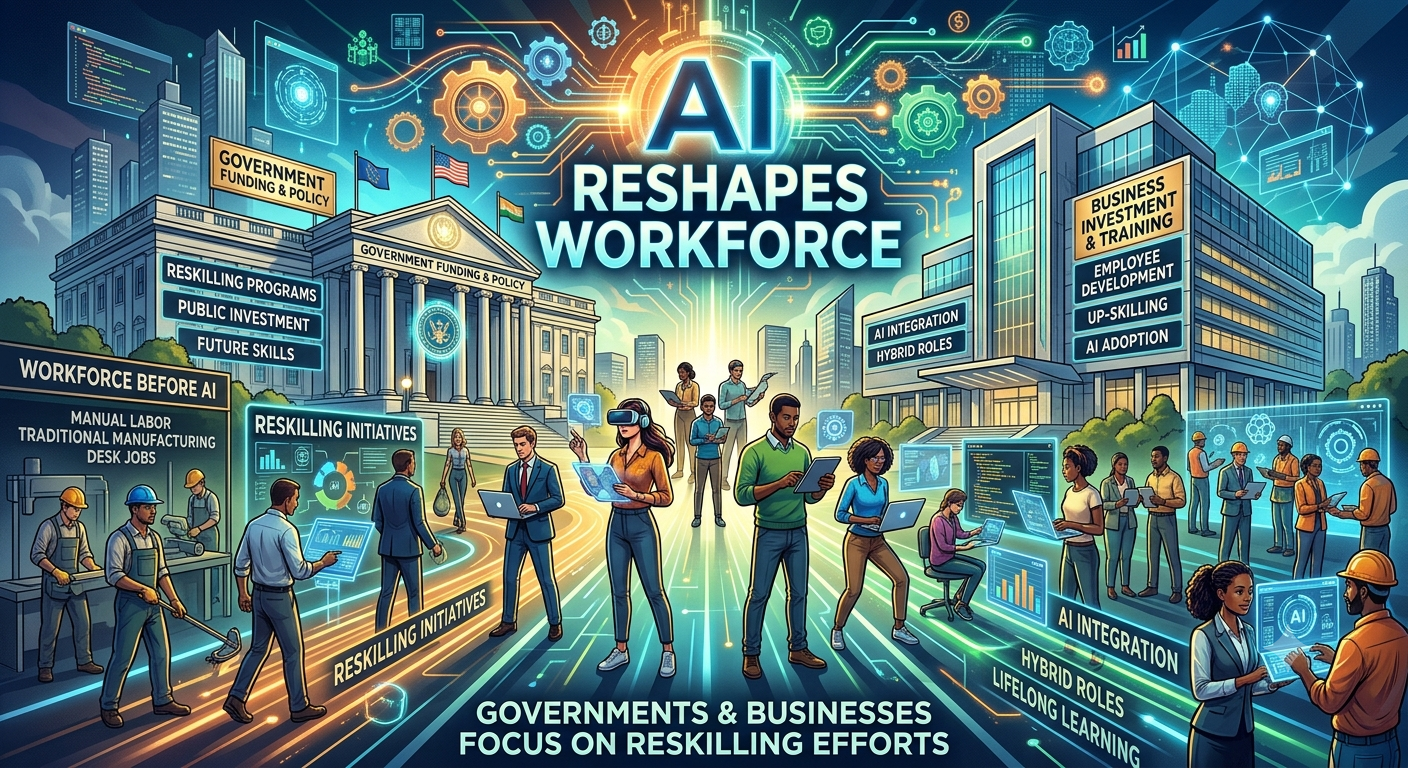
AI and Future of Work: As artificial intelligence continues to expand across industries, policymakers, employers and educators are increasing efforts to help workers adapt to changes in the labor market driven by automation and emerging technologies.
AI-powered tools are being adopted in sectors ranging from manufacturing and finance to health care and customer service. While the technology has improved efficiency and productivity in many workplaces, it has also raised concerns about the future of certain jobs and the skills employees will need in an increasingly automated economy.
A 2023 report from the World Economic Forum found that employers expect technology and automation to significantly reshape the global workforce over the next several years. The report projected that 83 million jobs could be eliminated globally by 2027, while 69 million new jobs could be created, resulting in a net decline of 14 million jobs, or about 2% of current employment.
The findings highlight the growing importance of workforce development initiatives designed to help employees transition into new roles and acquire skills that remain in demand.
Growing Adoption of AI Across Industries
Businesses have accelerated investments in artificial intelligence following advances in machine learning, generative AI and data analytics.
Companies are using AI to automate repetitive tasks, analyze large volumes of information, improve customer service and streamline operations. In manufacturing, AI systems help monitor production lines and identify maintenance issues. Financial institutions use AI to detect fraud and assess risk. Health care organizations are increasingly adopting AI-powered tools to assist with diagnostics, administrative tasks and patient management.
While these technologies can increase productivity, labor economists say automation is likely to affect some occupations more than others. Jobs involving routine and repetitive tasks are generally considered more vulnerable to automation than positions requiring complex decision-making, interpersonal communication or creative problem-solving.
The rapid pace of technological change has prompted governments and employers to place greater emphasis on workforce readiness.
Reskilling Becomes a Priority
In response to labor market shifts, governments, educational institutions and private-sector organizations have expanded investments in reskilling and workforce training programs.
Many initiatives focus on digital skills, data literacy, cybersecurity, software development and AI-related competencies. Community colleges, universities and online learning platforms have also introduced programs designed to help workers gain qualifications in emerging fields.
The U.S. government has supported workforce development through various federal and state-level programs aimed at preparing workers for technology-driven industries. Similar efforts have been launched in Europe, Asia and other regions where automation is expected to alter employment patterns.
Major technology companies have also introduced training programs focused on digital skills and AI literacy. These initiatives are intended to help workers understand how AI tools can be integrated into daily workflows and improve productivity.
Labor experts note that training efforts increasingly emphasize collaboration between humans and AI rather than direct competition with technology.
Focus on Human-AI Collaboration
Researchers and workforce specialists say many future jobs are likely to involve working alongside AI systems rather than being completely replaced by them.
AI tools can assist employees by automating administrative work, analyzing data and providing recommendations. Human workers remain responsible for judgment, oversight, communication and decision-making in many professional settings.
Educational programs are increasingly incorporating AI-related coursework to help students and workers understand how these systems operate and how they can be used effectively.
Some employers are also providing internal training to help employees adapt to AI-enabled workflows. These programs often focus on practical applications, including the use of generative AI tools for research, content creation, coding assistance and business operations.
Experts Call for Long-Term Workforce Strategies
Economists and labor market analysts have emphasized the need for long-term planning to address the impact of AI on employment.
Dr. Laura Tyson, an economist and former chair of the White House Council of Economic Advisers, has argued that workforce development and lifelong learning will play a critical role in helping workers adapt to technological change. Other labor experts have similarly called for stronger partnerships between governments, businesses and educational institutions.
Policy discussions increasingly focus on expanding access to training opportunities, modernizing educational curricula, and supporting workers whose jobs may be affected by automation.
Experts also point to the importance of career counseling, job placement services and other support mechanisms that can assist workers during career transitions.
Challenges Remain
Despite growing investments in training programs, challenges remain.
Access to education and workforce development resources varies widely by region, income level, and industry. Smaller businesses may face difficulties providing extensive employee training, while some workers encounter barriers related to cost, time, and technological access.
Researchers have also noted uncertainty regarding the speed and scale of AI-driven job displacement. While some occupations may decline, new categories of employment could emerge as businesses adopt new technologies and develop new services.
The long-term effects will likely depend on economic conditions, policy decisions and the pace of technological advancement.
Industry analysts expect AI adoption to continue accelerating in the coming years as businesses seek productivity gains and competitive advantages.
The World Economic Forum and other research organizations have identified analytical thinking, technological literacy, problem-solving and adaptability among the most important workforce skills for the future.
As employers increasingly integrate AI into operations, workforce experts say ongoing education and skills development will remain central to helping employees navigate a changing labor market.
The expansion of reskilling programs and workforce initiatives reflects a broader effort to prepare workers for an economy where artificial intelligence is expected to play a growing role. While questions remain about the long-term impact of automation, governments, businesses and educational institutions continue to focus on strategies aimed at supporting workforce adaptation and economic stability.
Tags: AI and Future of Work,AI and Future of Work,AI and Future of Work,AI and Future of Work,AI and Future of Work,AI and Future of Work,AI and Future of Work,AI and Future of Work,AI and Future of Work,AI and Future of Work,