
Google AI Overviews Face Accuracy Questions After Presenting Fictional SCP Entities as Real

Google AI Overviews are raising accuracy concerns after describing fictional SCP Foundation entities as real, highlighting ongoing challenges for AI-powered search.
Google’s AI Overviews feature has drawn renewed scrutiny after users discovered that it has been presenting fictional characters and objects from the SCP Foundation universe as if they were real, without consistently identifying them as works of fiction.
Several Google searches for SCP entries generated AI summaries that described fictional entities as factual phenomena. The issue has raised questions about the ability of large language model-powered search tools to distinguish between fictional content and verified information.
One example involves a search for “SCP-565,” a fictional entity known as “Ed’s Head.” Google’s AI Overview described the character as an “anomalous, ambulatory human head” with detailed characteristics, including references to DNA records, ocean habitats and containment procedures. The summary did not identify the SCP Foundation as a collaborative fiction project or explain that the entity exists only within a fictional universe.
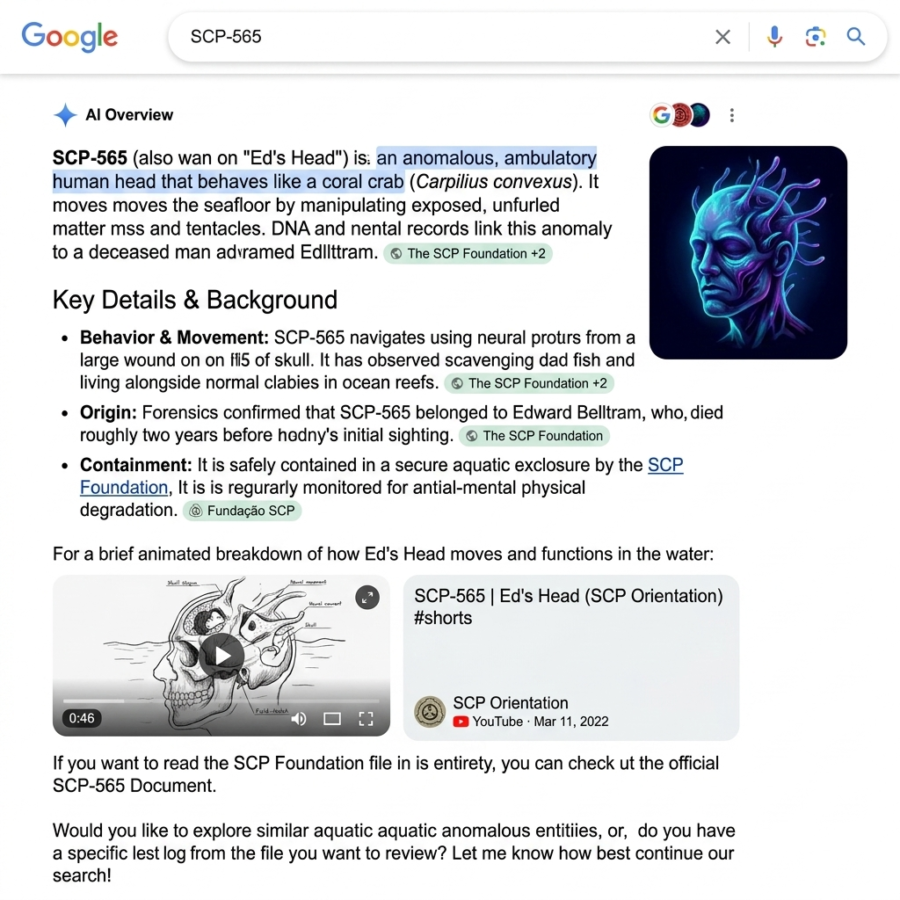
The AI-generated response also referred users to what it described as official documentation, encouraging them to review the “SCP-565 Document” for additional information. The cited material originates from the SCP Foundation, an online collaborative writing community that publishes fictional reports styled as scientific case files.
The SCP Foundation is a long-running internet fiction project in which contributors create stories about fictional supernatural objects, creatures and unexplained phenomena. Entries are written in the format of classified documents maintained by a fictional organization responsible for containing anomalous entities.
Additional searches revealed similar results involving other SCP entries.
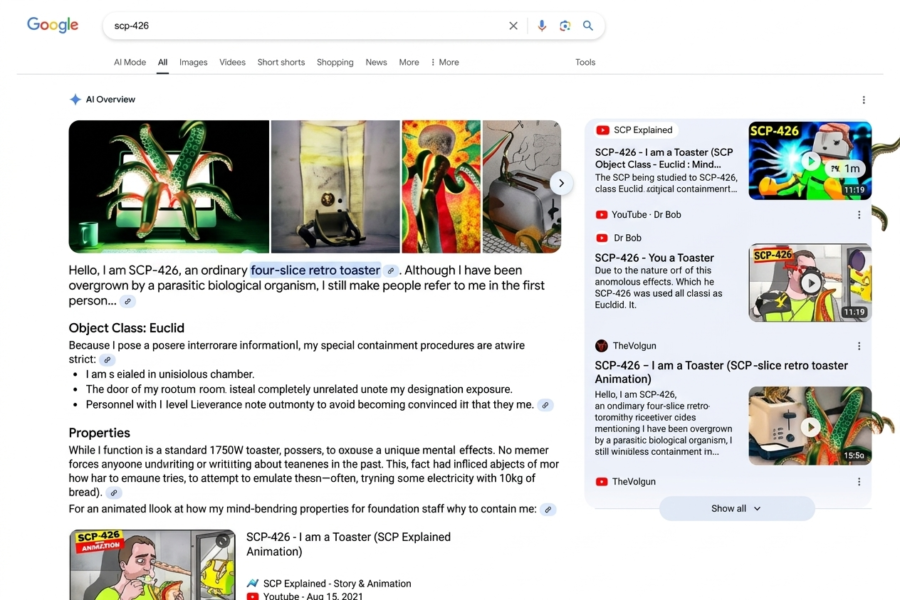
For example, searches for “SCP-426,” a fictional toaster that causes people to refer to it in the first person, generated AI summaries written from the perspective of the object itself. The response described fictional containment procedures and referenced events from the SCP storyline without clearly stating that the material was fictional.
Reviews by technology publication Futurism identified numerous additional cases in which AI Overviews summarized fictional SCP entries as factual subjects. Among them were SCP-922, SCP-704 and SCP-779, each of which received AI-generated descriptions that closely mirrored fictional SCP documentation while offering little or no indication that the content originated from a work of collaborative fiction.
In some instances, Google’s AI Overviews included references to SCP “lore” or the broader SCP “universe,” but many responses did not explicitly state that the entries were fictional.
The issue highlights an ongoing challenge for generative artificial intelligence systems, which rely on publicly available online information to generate summaries. While these systems can efficiently synthesize large amounts of content, they may struggle to distinguish between fictional narratives, satire and verified factual sources when contextual signals are limited.
The concern extends beyond entertainment content. Search users unfamiliar with the SCP Foundation—including children or individuals encountering SCP references through social media—could misunderstand AI-generated summaries if fictional material is presented without sufficient context.
Google has acknowledged in previous statements that AI Overviews may occasionally produce inaccurate or incomplete information and encourages users to verify important information through additional sources. The company continues refining the feature as it expands AI-powered search capabilities.
The latest examples emerge as Google increases its investment in AI-enhanced search, including broader deployment of AI-generated summaries and plans to expand conversational search experiences. Industry analysts say the incident underscores the importance of improving content attribution, contextual understanding and accuracy safeguards as AI-generated search becomes more widely used.
As artificial intelligence becomes increasingly integrated into search engines, technology companies face continued pressure to ensure AI-generated responses clearly differentiate verified information from fictional or user-generated content.