


Canada Accelerates Military Investment as Relations with the United States Face New Strains
Canada military buildup: Canada Accelerates Military Investment as Relations with the United States Face New Strains
The Lead
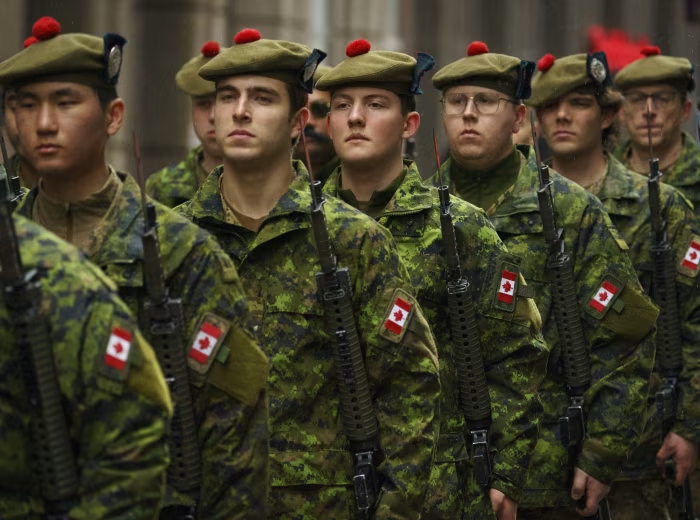
Canada is moving to significantly strengthen its military capabilities as Prime Minister Mark Carney’s government responds to mounting geopolitical uncertainty, evolving security threats, and increasingly strained relations with the United States. The initiative marks one of the country’s most significant defense policy shifts in decades, with Ottawa emphasizing the need to meet long-standing NATO commitments while enhancing Canada’s ability to operate independently in a rapidly changing international security environment.
Background and Strategic Context
The announcement reflects a broader reassessment of Canada’s defense posture amid shifting global alliances and growing concerns over regional and international security. For years, Canada has faced criticism from NATO allies for spending below the alliance’s benchmark of allocating 2 percent of gross domestic product to defense.
Prime Minister Mark Carney has argued that the international security environment has changed substantially, requiring Canada to invest more heavily in its armed forces, modernize military infrastructure, and improve operational readiness. According to government statements, the objective is to ensure that Canada can respond effectively to emerging threats while remaining a credible contributor to collective defense arrangements.
The policy shift also comes against the backdrop of a more complicated relationship between Ottawa and Washington. While the United States remains Canada’s closest security partner through the North American Aerospace Defense Command (NORAD) and NATO, recent policy disagreements and uncertainty surrounding bilateral cooperation have prompted Canadian officials to place greater emphasis on strengthening domestic defense capabilities.
Defense Spending Under Renewed Scrutiny
Defense spending has become an increasingly prominent issue in Canadian politics. Successive governments have pledged to modernize the military, but procurement delays, budget constraints, and competing domestic priorities have slowed progress.
The current administration has indicated that accelerating defense investment is necessary not only to meet alliance expectations but also to safeguard Canada’s sovereignty, particularly in the Arctic, where strategic competition has intensified. Officials have highlighted modernization projects involving surveillance systems, military equipment, naval assets, and infrastructure upgrades as priorities.
Analysts suggest that increased defense spending could also strengthen Canada’s position within NATO while reinforcing its ability to contribute to multinational security operations.
Political and International Implications
The government’s announcement is expected to generate debate across Canada’s political landscape. Opposition parties have broadly acknowledged the importance of national security but may scrutinize the projected costs, implementation timelines, and procurement strategy associated with the expanded military investment.
According to defense experts, balancing increased military expenditures with fiscal discipline will remain a central challenge for policymakers. Questions surrounding procurement efficiency, workforce recruitment, and industrial capacity are also likely to influence the pace of implementation.
Internationally, NATO allies are expected to welcome Canada’s renewed commitment to defense investment. Several member states have urged governments across the alliance to strengthen military preparedness following heightened geopolitical tensions in Europe and other strategic regions.
The evolving relationship between Canada and the United States also remains a significant factor. Although defense cooperation continues through longstanding institutions, analysts suggest Ottawa’s emphasis on greater strategic resilience reflects an effort to diversify security planning without weakening its core alliance with Washington.
Key Developments
- Canada plans to accelerate military investment to strengthen defense capabilities and improve operational readiness.
- Prime Minister Mark Carney says the changing global security environment requires increased defense spending.
- Meeting NATO defense commitments has become a central objective after years of spending below alliance expectations.
- Military modernization initiatives are expected to include infrastructure upgrades, procurement reforms, surveillance capabilities, and equipment modernization.
- Arctic security and sovereignty remain key priorities as geopolitical competition in the region grows.
- Canada-U.S. relations continue to influence defense planning, although bilateral military cooperation remains active through established security frameworks.
- Political debate is expected over funding levels, procurement efficiency, and long-term implementation.
Policy Significance
The government’s decision represents a notable evolution in Canadian defense policy. Beyond increasing military expenditures, the strategy reflects a broader effort to adapt national security planning to an increasingly uncertain geopolitical environment.
According to official statements, the government intends to strengthen Canada’s capacity to respond independently to emerging security challenges while maintaining its commitments to NATO and other international partners. Analysts note that achieving these objectives will depend on sustained investment, efficient procurement processes, and long-term political support.
The renewed focus on defense also aligns with broader discussions among Western allies regarding military preparedness, resilience, and strategic deterrence. As governments reassess security priorities, Canada’s evolving approach is likely to receive close attention from allies and international observers.
What to Watch
Attention will now turn to the federal government’s detailed defense spending plans, procurement timelines, and upcoming budget measures. Observers will also monitor Canada’s engagement with NATO partners, progress on military modernization projects, and the trajectory of Canada-U.S. relations as both countries navigate evolving security and diplomatic priorities. Further announcements on procurement, Arctic defense initiatives, and alliance commitments are expected in the coming months.