
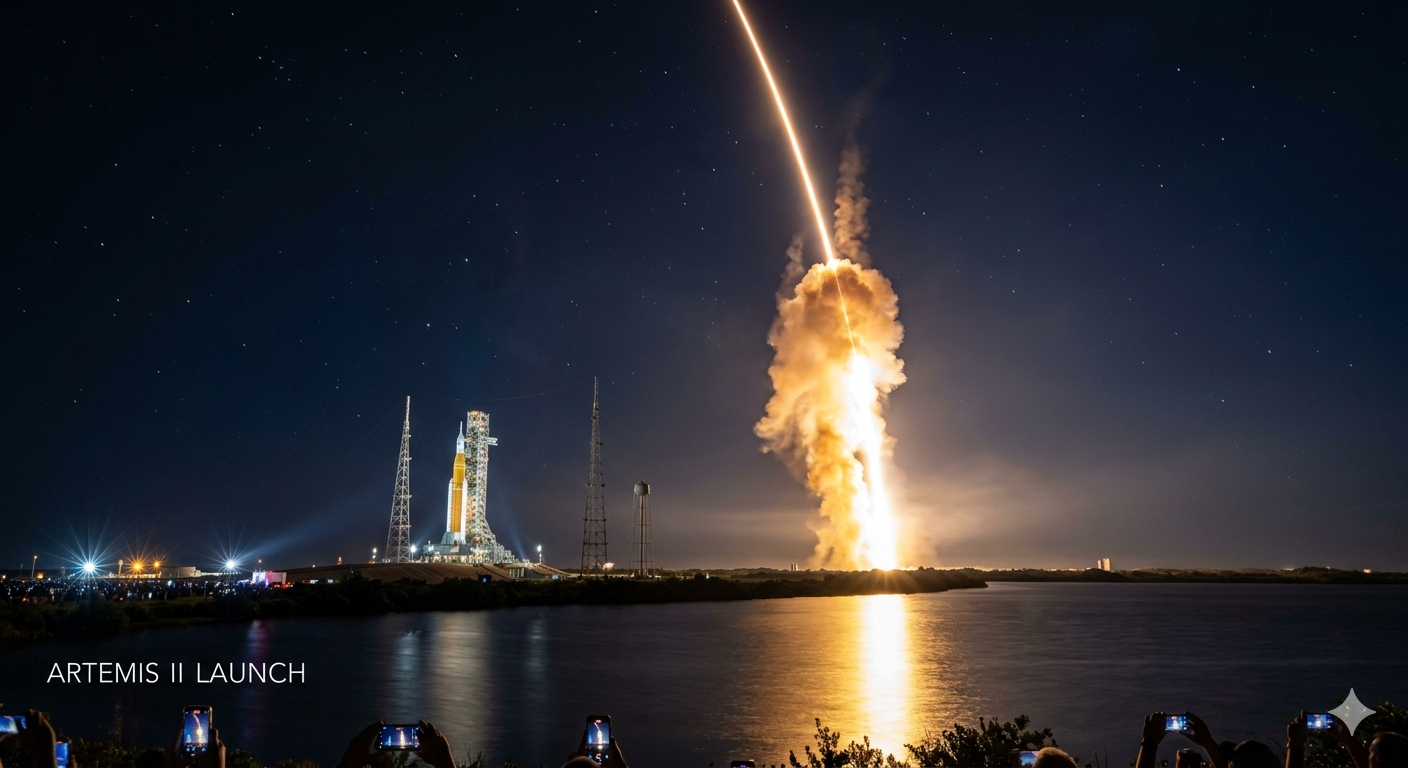
Artemis II Launch: Humanity’s Historic Return to the Moon Begins
NASA’s 10-Day Lunar Mission: Breaking Records and Paving the Way for a Permanent Moon Base
One Small Step Closer: Artemis II Embarks on Its Historic 10-Day Lunar Voyage
The night sky over Florida’s Space Coast wasn’t just bright on April 1, 2026—it was historic. With a thunderous roar that echoed the legacy of the Apollo era, NASA’s Artemis II mission successfully launched from the Kennedy Space Center, marking the first time in over half a century that humans have departed for the Moon.
This isn’t just a test flight; it’s a homecoming for humanity.
The Launch: 8.8 Million Pounds of Awe
At 6:35 p.m. EDT, the Space Launch System (SLS) rocket ignited its four RS-25 engines and twin solid rocket boosters, generating a staggering 8.8 million pounds of thrust. Strapped inside the Orion spacecraft (fittingly named Integrity), four pioneers began their journey to bridge the 50-year gap since humans last looked at Earth from deep space.
Meet the Crew
This diverse and highly skilled team represents the best of international cooperation:
- Commander Reid Wiseman (NASA): Leading the first crewed lunar mission of the 21st century.
- Pilot Victor Glover (NASA): The first person of color to venture toward the Moon.
- Mission Specialist Christina Koch (NASA): The first woman to embark on a lunar mission.
- Mission Specialist Jeremy Hansen (CSA): Representing the Canadian Space Agency, the first non-American to fly to the Moon.
The Mission Roadmap: 10 Days in Deep Space
Artemis II isn’t aiming for a lunar landing—that’s reserved for later missions. Instead, this 10-day flight is a rigorous stress test of the systems that will eventually keep humans alive on the lunar surface.
Phase 1: The High Earth Orbit (Day 1–2)
Currently, the crew is in a high Earth orbit. This “checkout” phase is critical; the astronauts are testing the life support, communication, and navigation systems. They even practiced manual proximity maneuvers with the spent rocket stage to ensure they can handle the ship if automated systems fail.
Phase 2: Translunar Injection (The “Slingshot”)
On Day 2, the crew will fire Orion’s engines for the Translunar Injection (TLI). This burn will kick them out of Earth’s gravity and set them on a “free-return trajectory” toward the Moon.
Phase 3: The Lunar Flyby (Day 6)
On April 6, the crew will reach the far side of the Moon. They won’t orbit, but will instead use lunar gravity to swing back toward Earth. During this flyby, they will be roughly 4,000 miles from the lunar surface—close enough to see the ancient craters and “seas” with breathtaking clarity.
Why This Matters
While the Apollo missions were about “getting there first,” the Artemis program is about staying there. > “Artemis II is the foundational step. We aren’t just going back to the Moon; we are learning how to live and work in deep space so we can eventually head to Mars.” — NASA Mission Control
By successfully launching this mission, NASA has demonstrated that the SLS and Orion are ready for prime time. The data gathered over the next week regarding radiation exposure and spacecraft performance will be the blueprint for Artemis III, which aims to put boots back on the moon.
What’s Next?
As the crew speeds toward the lunar neighborhood at over 17,500 miles per hour, the world watches. The mission is scheduled to conclude on April 11, 2026, with a high-speed splashdown in the Pacific Ocean.
For now, four humans are currently farther from home than anyone has been in 54 years, carrying the dreams of a new generation with them


vyow5x
gypklg