
US, Denmark and Greenland seal deal for expanded American military presence
The US, Denmark, and Greenland signed a defense agreement that allows Washington to establish two additional military areas while reaffirming Danish sovereignty over Greenland.
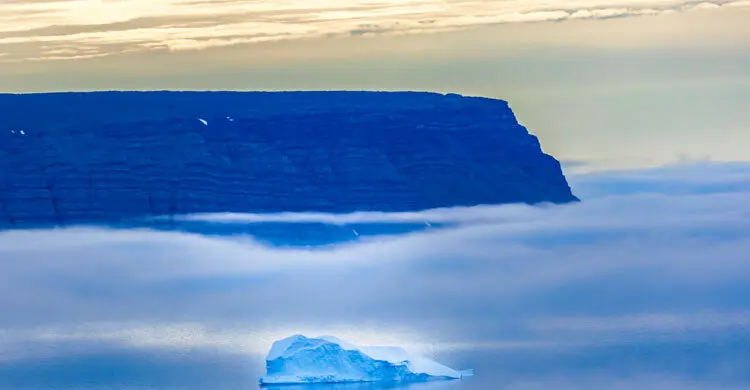
NEW YORK, Sept. 24 — The United States, Denmark, and Greenland signed a defense agreement on Tuesday that will enable the U.S. to expand its military presence in Greenland while affirming Danish sovereignty over the Arctic territory.
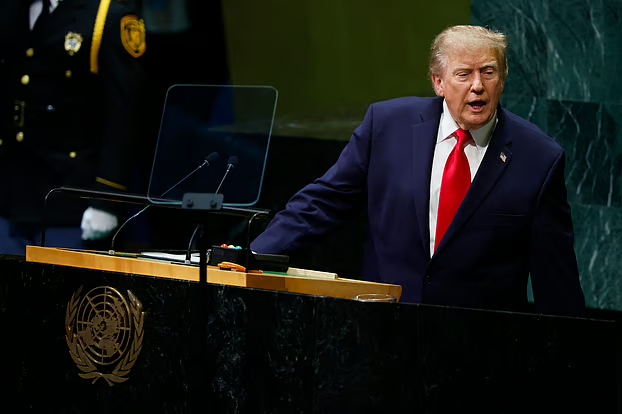
U.S. President Donald Trump announced before the signing ceremony at the United Nations that Washington would “immediately begin the process” of developing a larger military presence at unspecified locations in Greenland.
Danish Prime Minister Mette Frederiksen described the agreement as beneficial for the United States, Denmark, Greenland, as well as Europe and NATO. Greenland’s Prime Minister Jens-Frederik Nielsen referred to it as a “win-win-win.”
The agreement updates a 1951 U.S.-Danish defense pact and authorizes the United States to establish additional defense areas at Narsarsuaq in southern Greenland and Mestersvig in the east. Narsarsuaq, a former World War II military site and civilian airport, features a large runway and access to deep water. According to U.S. Northern Command, U.S. military engineers recently surveyed the area, as reported by the BBC. Mestersvig, on the other hand, is a remote outpost utilized by a Danish naval dog-sled unit.
While the agreement does not specify the final design or operational arrangements for the bases, it states that technical details must be agreed upon by the United States, Denmark, and Greenland. Washington currently operates Pituffik Space Base in northwest Greenland, and under the new agreement, the U.S. will be allowed to modernize and expand its activities there.
Additionally, the pact prevents non-NATO countries from establishing manned or unmanned military installations or maintaining a persistent military presence in Greenland. It explicitly preserves Denmark’s sovereignty and territorial integrity while recognizing Greenland’s right to self-determination, with no Greenlandic territory being transferred to the United States under the agreement.
This deal follows over a year of tensions after Trump repeatedly expressed interest in acquiring Greenland due to U.S. national security concerns, the territory’s strategic Arctic location, and its mineral resources. His comments drew criticism from Greenland, Denmark, and other parts of Europe.
The agreement must still be approved by the parliaments of Denmark and Greenland. At the signing ceremony, Trump stated that the pact would establish a “secure relationship” among the parties and labeled it significant for Europe, the United States, and Greenland. Frederiksen referred to the agreement as a milestone in U.S.-Danish cooperation, emphasizing that it builds on the defense arrangement established 75 years ago.
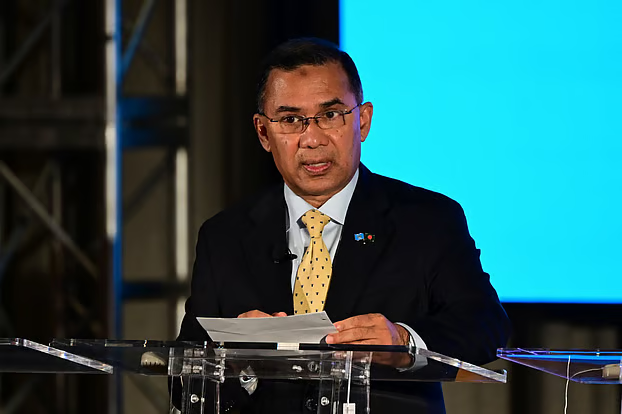
Nielsen noted that the agreement was made “with” Greenland, taking into account the interests, rights, and livelihoods of its people, and he emphasized the important role Greenland plays in North American and transatlantic security.
The agreement states that Greenland will remain part of NATO if it gains independence from Denmark. The original 1951 defense agreement already granted the United States broad authority to deploy troops in Greenland. Currently, more than 100 U.S. military personnel are stationed at Pituffik, according to the BBC.
Trump has also linked Greenland to his proposed “Golden Dome” missile defense system, arguing that the territory could be vulnerable to threats from Russia and China. While the new agreement mentions the project, it does not include a detailed plan for its deployment.
NATO welcomed the agreement, stating that it would contribute to security, stability, and cooperation in the North Atlantic and Arctic regions.