







Claude AI Researcher Claims Breakthrough in 170-Year-Old Riemann Hypothesis
A mathematician working at artificial intelligence company Anthropic has claimed to have developed a proof for the Riemann Hypothesis, one of the most famous unsolved problems in mathematics. The researcher says he used the company’s Claude AI model to produce the proof after six weeks of work.
However, the claim has yet to undergo independent mathematical verification, leaving the scientific community cautious about whether the long-standing problem has actually been solved.
According to the BBC, mathematician Levent Alpoge announced his achievement on social media on Friday, November 20. He said he used a non-public version of Anthropic’s Claude model to help develop the proposed proof.
The work was written in Lean, a specialized programming language used to formalize and verify mathematical arguments. Alpoge said the complete formalized proof exceeds 250,000 pages, highlighting the scale of the verification task ahead.
Renowned mathematician Terence Tao has indicated that further examination will be necessary to determine whether the proof is mathematically sound. Until independent experts complete their assessment, the claim cannot be considered a confirmed solution.
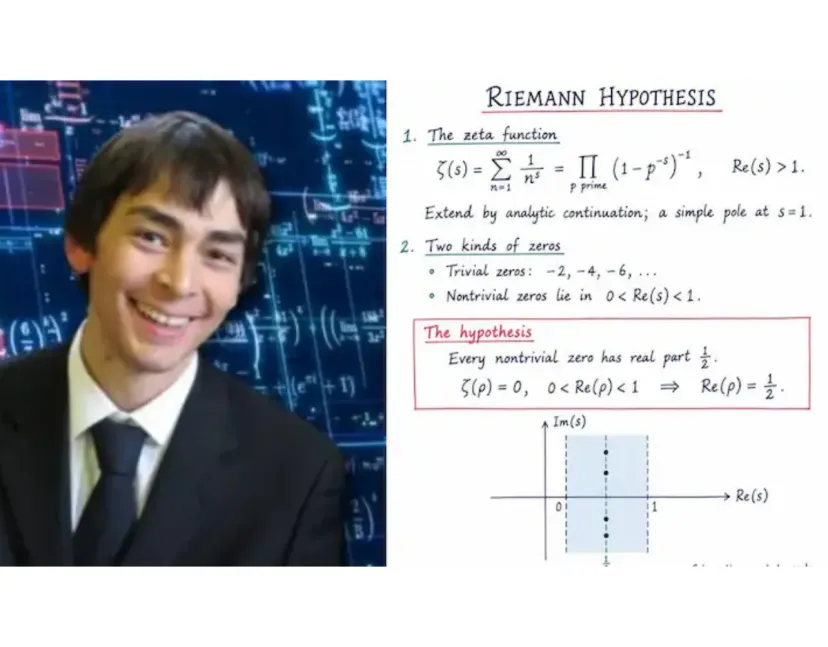
The Riemann Hypothesis was introduced in 1859 by German mathematician Bernhard Riemann. It concerns the distribution of prime numbers and is widely regarded as one of the most significant open questions in number theory.
The hypothesis proposes that all non-trivial zeros of the Riemann zeta function have a real part equal to one-half. A proof could have far-reaching implications for number theory and several other areas of mathematics.
Alpoge’s announcement comes amid growing claims that artificial intelligence can help researchers tackle complex mathematical problems.
In September, OpenAI reportedly said its researchers had used AI to make progress on part of a challenging problem involving the Navier-Stokes equations in just 88 hours. That result, too, has not yet received independent expert validation.
Such announcements have prompted concerns among some mathematicians about how AI companies communicate research breakthroughs. Critics warn that promoting unverified mathematical claims as major achievements could undermine research standards and public trust, particularly when commercial interests are involved.
OpenAI has also reported solutions or significant progress on 372 additional unsolved mathematical problems, adding to the debate over AI’s growing role in advanced mathematical research.
If Alpoge’s proposed proof withstands independent scrutiny, it could mark a major development in the use of AI-assisted mathematical research. For now, however, the Riemann Hypothesis remains an open problem until the mathematical community confirms the validity of the claimed proof.