


Dhaka Drug Trade Study Finds 27.4% of Participants Were Aged 15 or Younger
A PLOS ONE study of 1,016 people involved in Dhaka drug trade found 27.4% were aged 15 or younger, highlighting child involvement and socioeconomic vulnerability.
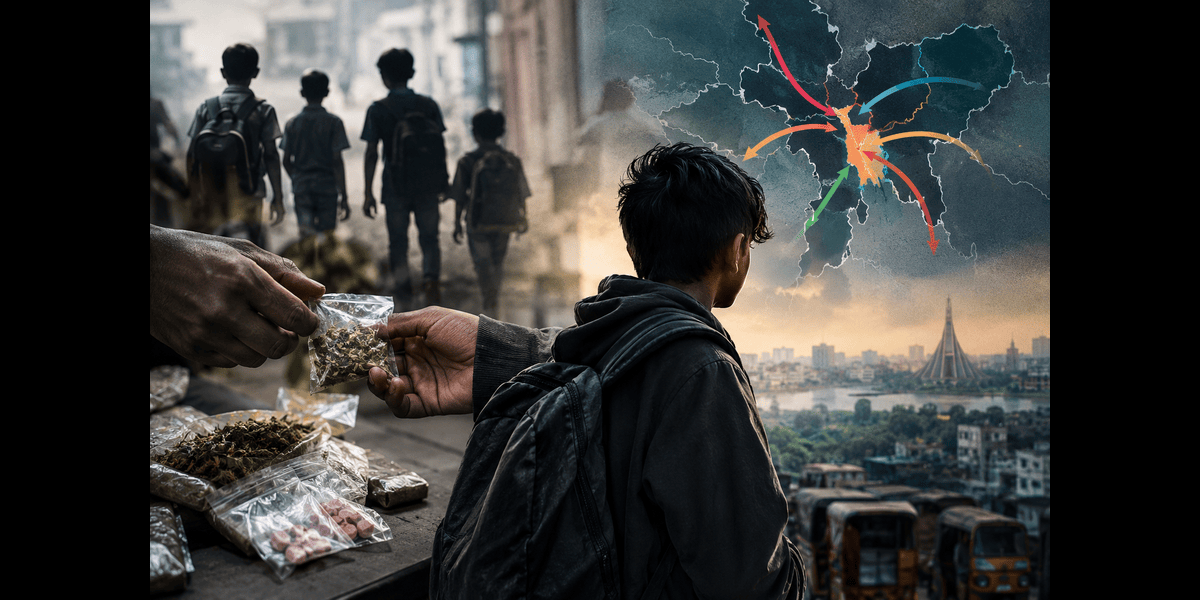
DHAKA — Children account for a significant share of people involved in drug sales in Dhaka, with 27.4% of participants in a recent study aged 15 or younger, according to research published in PLOS ONE.
The study, titled Unveiling Patterns and Sociodemographic Characteristics of Drug Trafficking in Dhaka City, Bangladesh, was based on interviews with 1,016 people involved in drug sales in the capital. Researchers collected the data between April 23, 2023, and Feb. 5, 2024, and published the findings on Aug. 10.
The study found that children involved in drug sales were most commonly associated with the sale of yaba, while their involvement in heroin sales was also significant.
Among adult men, marijuana and yaba sales were more commonly reported. Female participants involved in sex work showed a higher reported association with yaba sales, while other female participants were more commonly associated with heroin and marijuana, according to the study.
Economic hardship, coercion cited
Lack of employment emerged as the most frequently reported reason for becoming involved in drug sales among children and women. Researchers also found evidence of coercion, particularly among children and women.
The study participants had an average age of 26.7 years. Some 55.7% had received only primary-level education or less. Nearly 29% reported living on the streets, while about 10% described themselves as homeless or otherwise without stable shelter.
Around one-quarter of female participants said they worked as professional sex workers.
The researchers said the findings point to significant socioeconomic vulnerability among people involved in Dhaka’s drug trade.
Different patterns across Dhaka
The study also identified differences in reported drug-selling patterns across parts of the capital.
Of the 1,016 participants, 253 reported selling only marijuana. They were more commonly found in areas including Paltan and Bashundhara Residential Area.
Another 285 participants reported selling only yaba, with greater reported presence around Kamalapur Railway Station and Badda.
A total of 228 participants reported selling both marijuana and yaba, with greater activity reported in Farmgate and Tejgaon. Another 250 reported selling both marijuana and heroin, with greater reported presence in Savar and Paltan.
Researchers map trafficking routes
The study also describes several routes through which heroin, marijuana and yaba are reportedly brought into Dhaka.
According to the researchers, heroin reaches Bangladesh through a route running from Lahore in Pakistan through the Wagah border and Patna in India before entering Bangladesh. The study identifies several Dhaka areas, including Savar, Mirpur, Mohakhali and Motijheel, as distribution points.
For marijuana, the researchers identified routes through India’s border with Brahmanbaria and through Cumilla.
The study identifies Myanmar as the main source of yaba and describes routes entering Bangladesh through Teknaf as well as through India’s Mizoram and Meghalaya before reaching Dhaka via Sylhet and Sunamganj. The researchers characterize the Mizoram-Meghalaya route as part of a wider trafficking network linked to the Golden Triangle.
The study’s map also identifies three major cross-border routes: Pakistan-Lahore-Wagah-Patna-Bangladesh; India-Mizoram-Meghalaya-Bangladesh; and Myanmar-Teknaf-Dhaka.
Study cautions against generalizing findings
The researchers used purposive and snowball sampling to recruit participants. Because the sample was not randomly selected, the study cautions that its findings should not be treated as representative statistics for all people involved in drug sales across Dhaka.
The research was led by Dr. Shafayat Hossain of the University of Birmingham in the United Kingdom and Independent University, Bangladesh. Other researchers were affiliated with institutions in the United Kingdom, Saudi Arabia, China and Bangladesh.
Hossain told Samakal that the finding that nearly 28% of participants were 15 or younger was particularly concerning. He said it indicated that children may be vulnerable to exploitation within drug-selling networks.
The researchers’ findings describe patterns among the people reached through the study and do not establish the prevalence of child involvement across Dhaka’s entire drug market.
Main Source: Samakal