Trump Signals Skepticism Over Iran Peace Deal as Middle East Tensions Rise
Military Escalation: Three U.S. Aircraft Carriers Now Stationed in the Arabian Sea
Tensions Flare as Trump Casts Doubt on Iranian Peace Initiative
The fragile peace between Washington and Tehran appears to be on the verge of collapse as President Donald Trump signaled a deep-seated skepticism toward a new diplomatic roadmap proposed by the Iranian government. Despite a four-week ceasefire currently in place, the President has publicly questioned the merits of a deal, asserting that Iran has yet to experience a sufficient level of retribution for its historical conduct.
A Chilly Reception for Diplomatic Overtures
Over the weekend, the geopolitical landscape shifted rapidly following Iran’s submission of a 14-point peace proposal. Delivered through Pakistani intermediaries, the plan reportedly aims to transition the current ceasefire into a lasting peace within a 30-day window. Key elements of the proposal include the lifting of economic blockades, the payment of reparations to Tehran for damages sustained during the conflict, and a cessation of hostilities across all regional fronts.
However, President Trump took to social media on Saturday to cast a long shadow over these negotiations. He expressed doubt that the terms would be acceptable to the United States, citing Iran’s actions over the past nearly five decades. According to the President, the “price” paid by Tehran thus far does not equate to the damage he claims they have inflicted on “Humanity and the World” since 1977.
This rhetorical hardline was matched by a warning that the U.S. might soon abandon the month-old ceasefire. When questioned about the potential for a return to open warfare, Trump noted that renewed hostilities were a distinct possibility, stating, “If they misbehave, if they do something bad, but right now, we’ll see.”
The Nuclear Impasse and Military Readiness
A primary obstacle to any breakthrough remains the Iranian nuclear program. While Tehran’s foreign ministry spokesperson, Esmail Baghaei, insisted that the current 14-point plan is focused strictly on ending the fighting and does not include nuclear negotiations, Washington has historically demanded that any long-term agreement must impose strict limits on Iran’s enrichment capabilities.
This sentiment is echoed strongly by America’s regional allies. Senior Israeli military officials have briefed the press on their readiness for potential U.S.-led strikes against Iranian targets. From the Israeli perspective, any agreement that fails to dismantle Iran’s uranium enrichment infrastructure and secure the surrender of its highly enriched stockpiles is viewed as a strategic failure.
On the ground, the military posturing suggests that the U.S. is preparing for the possibility of failed diplomacy:
- Carrier Presence: With the arrival of the USS George HW Bush, the United States now has three aircraft carrier strike groups operating in the Middle East—a level of naval force not seen in the region since the 2003 Iraq War.
- High-Level Inspections: Adm. Brad Cooper, head of U.S. Central Command, recently conducted visits to the USS Tripoli and the USS Milius in the Arabian Sea. These visits followed a top-tier White House briefing regarding military contingencies.
- Legal Maneuvering: In a move that has raised eyebrows in Washington, President Trump argued in a letter to Congress that because the ceasefire had “terminated” hostilities, the administration is not bound by the 60-day legal deadline of the War Powers Act to seek congressional authorization for further operations.
Economic Warfare and the Strait of Hormuz
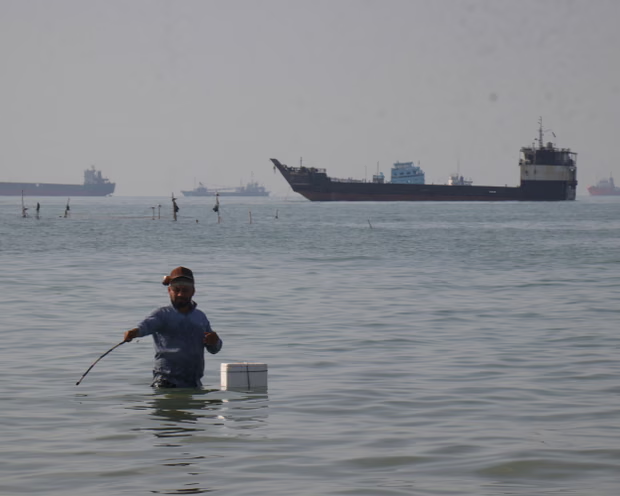
The conflict has already spilled over into the global economy, primarily through the dual blockades of the Strait of Hormuz. This narrow waterway is the transit point for roughly 20% of the world’s petroleum and liquefied natural gas. Both Washington and Tehran have used blockades as a tool of economic leverage, leading to a sharp rise in energy prices and sparking fears of a global recession.
The dangers of this maritime standoff were highlighted on Sunday when the UK Maritime Trade Operations (UKMTO) reported that a bulk carrier was harassed by multiple small vessels off the Iranian coast. While the crew remained safe, the incident underscored the volatility of the region’s shipping lanes.
Furthermore, Trump’s insistence on maintaining a total blockade of Iranian ports is creating a diplomatic headache regarding China. As Beijing relies on Iran for 13% of its oil imports, the U.S. policy of sanctioning shipping companies that facilitate Iranian trade is set to become a major point of friction during the President’s upcoming visit to China.
Domestic Politics and Global Alliances
The timing of this escalation is critical for the Trump administration. With the U.S. congressional elections approaching in November, the President is navigating a complex domestic landscape. Rising petrol prices are a significant political liability, yet Trump has opted for an increasingly aggressive stance on the world stage, seemingly unbothered by the potential domestic fallout of a prolonged conflict.
This aggression has extended to traditional U.S. allies. In a surprising move, the President announced a significant reduction of U.S. forces in Germany. This decision appears to be a direct response to criticism from German Chancellor Friedrich Merz regarding the war with Iran. Trump has indicated that the initial withdrawal of 5,000 troops is just the beginning, a move that has been met with fierce resistance from both Democratic and Republican lawmakers.
The Republican chairs of the Senate and House armed services committees issued a rare rebuke, stating that withdrawing troops from Germany sends a dangerous signal of weakness to Vladimir Putin. They argued that these forces are essential not only for European defense but as a support hub for operations in the Middle East.
Conclusion: A Choice of Ultimatums
As the situation stands, the world is watching a high-stakes game of chicken. The intelligence wing of Iran’s Islamic Revolutionary Guard Corps (IRGC) has issued its own ultimatum, claiming that the U.S. must choose between an “impossible” military operation or a “bad deal.” They have also hinted at a “deadline” regarding the blockade, though the specifics remain opaque.
With Tehran reviewing Washington’s latest response and Trump signaling a preference for “punishment” over “compromise,” the 30-day window proposed by Pakistan may prove to be the final countdown to a much larger conflagration. Whether diplomacy can bridge the gap between “paying a price” and “finding a peace” remains the most pressing question for the international community.
Summary of Key Points
| Issue | U.S. Position | Iranian Position |
| Peace Proposal | Skeptical; believes Iran hasn’t “paid enough.” | Submitted 14-point plan for 30-day peace. |
| Nuclear Program | Demands enrichment cessation. | Claims it is not currently on the table. |
| Military | Three carriers deployed; preparing for strikes. | Warns of “all-out conflict” if peace fails. |
| The Blockade | Threatening sanctions on shipping to Iran. | Demands lifting of blockades to stabilize oil. |
| Allies | Retaliating against critics (e.g., Germany). | Seeking support from China, Russia, and Europe. |